
DC Surge Protection Device
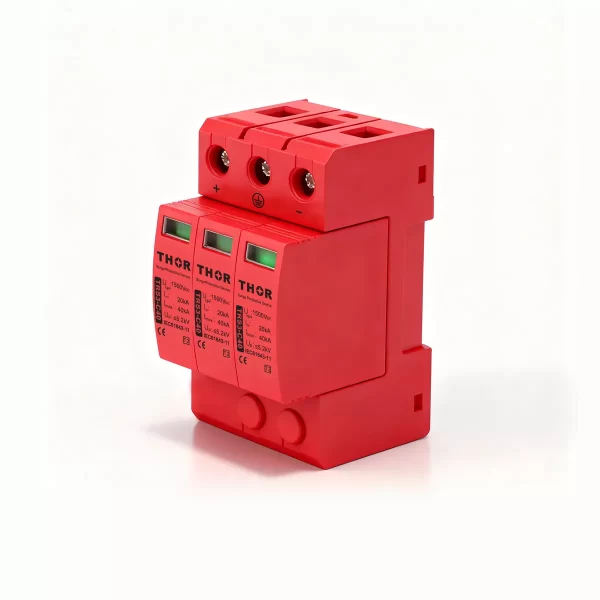
DC Surge Protective Devices — Industrial, Telecom & Battery Storage Protection
Thor manufactures DC surge protective devices (DC SPDs) for low-voltage direct-current power systems across industrial, telecommunications, and energy storage applications. Our DC SPD range covers Uc ratings from 24V to 180V DC, providing transient overvoltage protection for sensitive DC-powered equipment including PLCs, RTUs, telecom base station power feeds, BESS battery management systems, and EV charging DC buses.
All units are IEC 61643-11 certified, CE marked, and designed for DIN-rail installation in industrial control cabinets and outdoor field enclosures. With Imax ratings up to 40kA and a compact form factor, Thor DC SPDs integrate easily into existing 24V, 48V, 75V, and 110V DC distribution architectures without modification to existing wiring.


Type 2 DC Surge Protective Devices
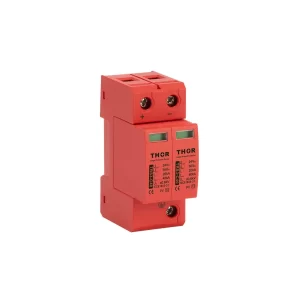
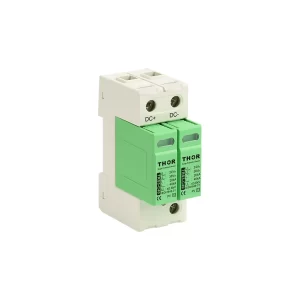
The TRS3-C40 DC SPD series provides Class II surge protection for low-voltage DC power circuits, suppressing induced transient overvoltages from lightning and switching operations. Available in four nominal voltage variants — 24V DC, 48V DC, 75V DC, and 110V DC — with corresponding Uc ratings of 36V, 65V, 80V, and 180V to ensure the SPD does not activate under normal operating conditions. Imax 40kA (8/20µs). DIN-rail mount, compact 2-pole format suitable for positive/negative rail protection.
Additional information
| Uocstc | 110v, 24v, 48v, 75v |
|---|---|
| Ucpv | 180v, 36v, 65v, 80v |
Additional information
| Uocstc | 110v, 24v, 48v, 75v |
|---|---|
| Ucpv | 180v, 36v, 65v, 80v |
Your questions answered
DC Surge Protection Device FAQs
What is a DC surge protection device?
A DC surge protective device (DC SPD) is installed in direct-current power circuits to limit transient overvoltages caused by nearby lightning strikes, switching operations, or electrostatic discharge events. It operates on the same fundamental principle as an AC SPD — using a Metal Oxide Varistor (MOV) to divert surge current to earth when voltage exceeds a set threshold — but is specifically designed and rated for DC system characteristics, including the absence of a natural current zero-crossing, which makes DC arc interruption a more demanding engineering requirement. DC SPDs are classified and tested under IEC 61643-11.
Can DC surge protectors be used for EV charging stations?
Yes. DC SPDs are a required component in EV charging station protection schemes per IEC 61851 and related installation standards. They are installed on the DC bus between the AC/DC rectifier and the charging port, protecting the EVSE power electronics from surge damage. Select a DC SPD with Uc exceeding the maximum DC bus voltage of the charger — typically 500V to 1000V DC for DC fast chargers (DCFC). For high-voltage EV charging applications above 200V DC, contact our technical team for appropriate product selection, as this falls outside the standard TRS3-C40 voltage range.
What is the difference between a DC SPD and a PV SPD?
Although both protect DC circuits, they are engineered for different environments and certified to different standards. A DC SPD (IEC 61643-11) is designed for industrial DC power systems — telecom feeds, battery banks, control panel supplies, and EV charging DC buses — operating at relatively stable, low-impedance DC voltages. A PV SPD (IEC 61643-31) is specifically engineered for the high-impedance, high-voltage characteristics of photovoltaic string circuits, and must meet additional requirements around DC arc suppression under open-circuit conditions. Never use a generic DC SPD in a PV string circuit — always use a PV-rated device.
Where are DC surge protection devices typically installed?
DC SPDs are installed in parallel with the DC load they protect, at the point of entry into a cabinet or enclosure, or directly at the terminals of sensitive equipment. Common installation points include: the DC output busbar of a rectifier or battery charger in a telecom base station; the 24V or 48V supply input of PLC and RTU control panels in industrial SCADA systems; the DC input of a battery energy storage system (BESS); and the DC bus of an EV charging station between the rectifier and the charging port. The SPD’s Uc rating must always exceed the maximum DC operating voltage of the circuit by at least 10%.
How do I select the correct Uc voltage for a DC SPD?
Select a Uc (maximum continuous operating voltage) equal to or greater than the maximum DC voltage that will appear across the SPD terminals under normal operating conditions — including any voltage ripple or tolerance. For a 24V DC system, select Uc ≥ 36V. For a 48V telecom system, select Uc ≥ 65V. For a 110V DC substation control circuit, select Uc ≥ 150V or 180V. Selecting a Uc too close to the operating voltage risks nuisance operation; selecting one too high reduces protection effectiveness. Thor’s DC SPD range offers Uc options of 36V, 65V, 80V, and 180V to match the most common industrial DC architectures.