
A surge protection device certificate is useful only when it covers the exact product you plan to buy. A genuine certificate for one model, voltage or SPD Type does not prove that a similar-looking product falls within the same scope.
Before approving a sample or bulk order, match the certificate to the quotation, datasheet and product label. Check the issuing body, certificate holder, model suffix, applicable standard, electrical ratings and current database record. If one field does not match, ask the supplier to explain the difference in writing.
The product below is a Thor TRS2-C40 2-pole, 320 V Type 2 model from Thor’s AC surge protection device range. Its visible label is useful evidence: it identifies the model family, voltage, SPD Type, In, Imax, Up and IEC 61643-11 reference that should be checked against the document package.
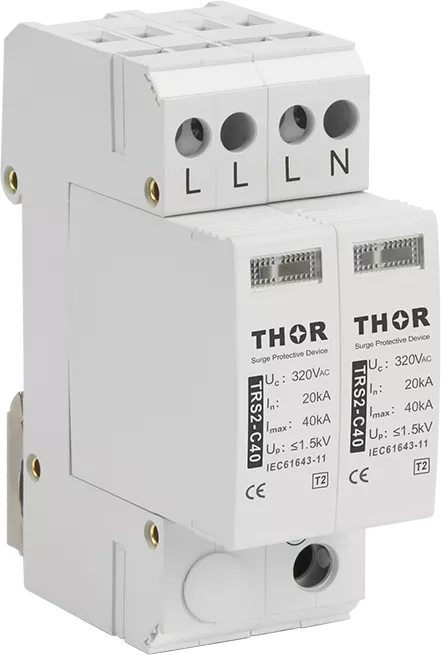
Figure 1 — Thor TRS2-C40 2-pole, 320 V AC Type 2 SPD with the product label visible for document matching.
What does a surge protection device certificate prove?
A surge protection device certificate records that the products within its stated scope were evaluated against named requirements by the issuing certification body. It does not cover every product sold by the certificate holder. Buyers must still match the quoted model, SPD Type, voltage, configuration and ratings to the certificate and its referenced test documents.
Certification bodies evaluate defined products against defined standards. TÜV Rheinland lists test reports, inspection reports, TÜV certificates and CB certificates among its SPD services for power and signal-line products.
Those documents do different jobs:
| Document | What it can show | What it does not prove by itself |
| Product certificate | Issuer, holder, covered models, standard and approved scope | That every model in the supplier’s catalogue is covered |
| Type-test report | Test setup, specimen details and recorded results for the evaluated product | That each production batch was retested to the full certification program |
| Datasheet | The supplier’s declared ratings and configurations | Independent third-party approval |
| Declaration of conformity | The manufacturer’s declaration against applicable requirements | Third-party certification unless the stated conformity route required such involvement |
| Batch QC or outgoing-inspection record | Checks performed on a production lot or shipment | Completion of the original product-certification program |
The distinction between a type-test report and a batch record matters. A buyer can ask for the report referenced by a certificate or for relevant extracts when available. That request is separate from asking what QC evidence accompanies a particular shipment.
Certificate scope also needs to match the classification in the quotation. If Type 1, Type 2, Type 3 or combined terminology is unclear, review the Type 1 vs Type 2 vs Type 3 SPD comparison before comparing document numbers.
Read the anatomy of a surge protection device certificate
Start with the document itself before comparing technical values. A professional layout or an official-looking seal is not enough. The useful evidence sits in fields that identify who issued the document, who owns it and which products it covers.
| Certificate field | What to read | Buyer check |
| Issuing body | Name of the certification body | Confirm that the body operates the stated certification scheme |
| Certificate number | Unique document reference | Search the issuer’s official database rather than relying on the PDF alone |
| Certificate holder | Legal company named on the document | Compare it with the manufacturer or responsible company in the transaction |
| Product and model scope | Model, family, suffixes and permitted variants | Check the complete quoted model, not just the shared series name |
| Standard and edition | IEC, EN, UL or other reference | Match the standard family to AC power, PV/DC or signal-line use |
| SPD Type or test class | Type 1, Type 2, Type 3 or combined classification | Compare it with the quotation and installation requirement |
| Ratings and configuration | Voltage, poles, protection mode and stated discharge ratings | Compare certificate, datasheet and label line by line |
| Issue, revision or status | Date, revision and current record | Check the live database for withdrawal, replacement or scope changes |
The two-page 2025 TÜV Rheinland example below shows why buyers need the complete certificate. Page 1 identifies certificate number `R 50680637 0001`, report number `CN250W9U 001`, the license holder, manufacturing site and IEC/EN 61643-11 standards. Page 2 carries the actual model scope and ratings, including the `TRS2-C40/320/aP` and `TRS2-C40/275/aP` variants, where the printed suffix rule defines the permitted pole variants.
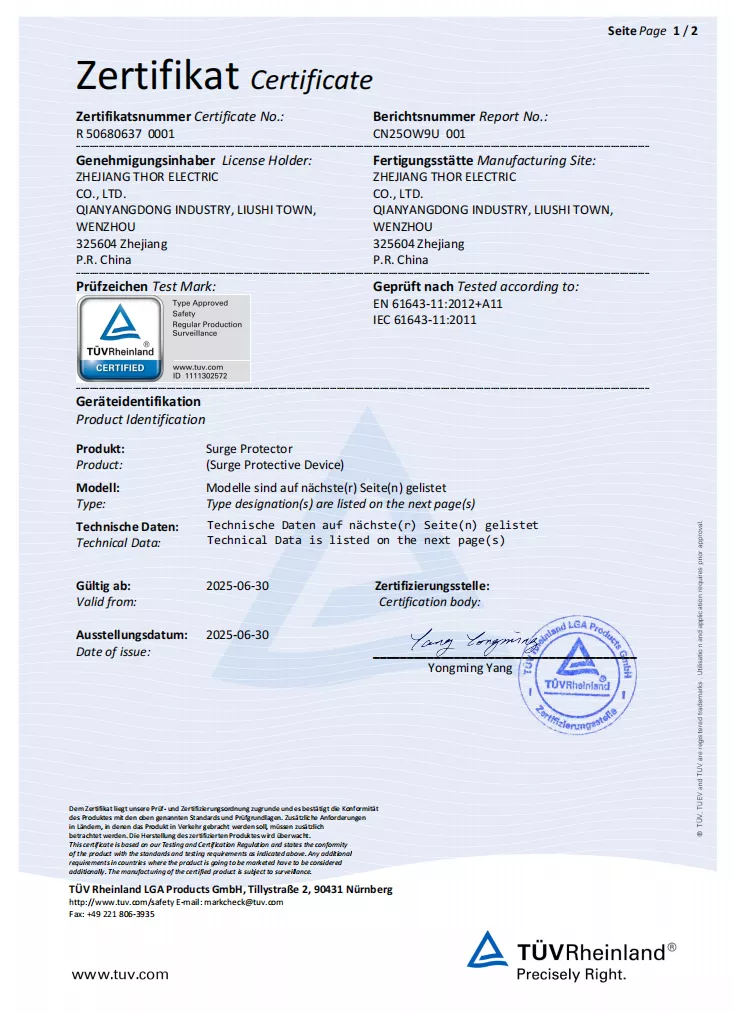
Figure 2 — Page 1 of Thor’s 2025 TÜV certificate, showing issuer, holder, certificate number, report reference and standards.
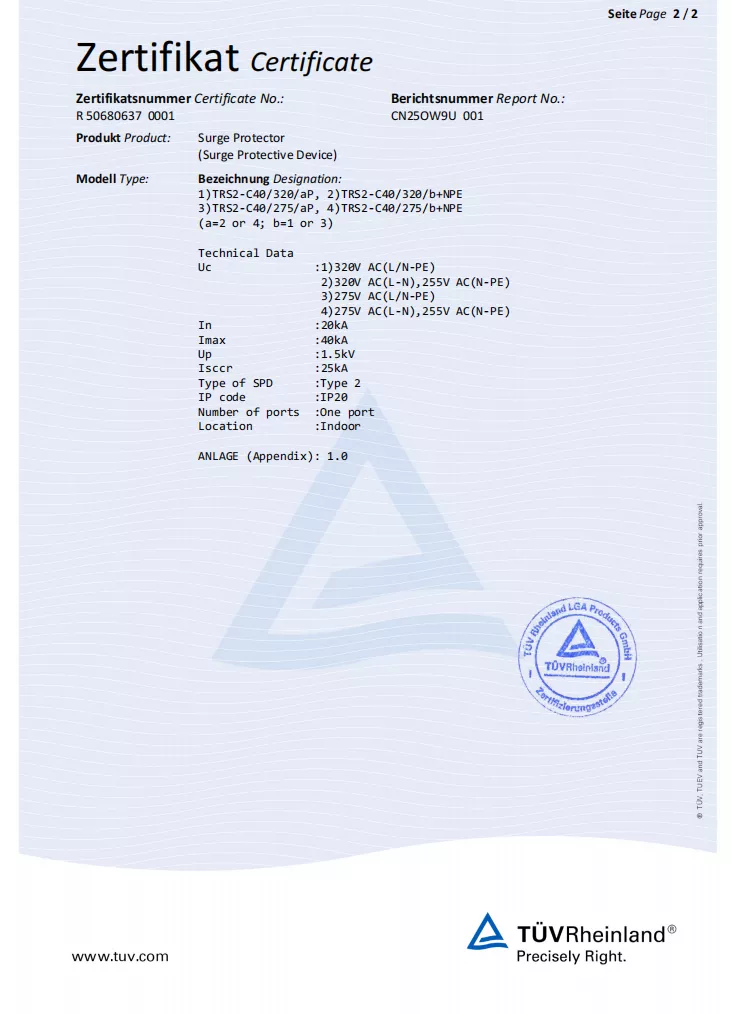
Figure 3 — Page 2 of the same TÜV certificate, showing the covered TRS2-C40 model variants and electrical ratings.
The product label and certificate scope are consistent on the points visible here: 320 V AC, Type 2, In 20 kA, Imax 40 kA and Up 1.5 kV. The document uses a family-and-suffix format while the device face shows the shorter `TRS2-C40` family name, so the pole configuration and ordering code still need to be retained in the quotation, datasheet and sample-approval record.
Thor’s SPD certificate library lists supplier-hosted document copies for review. Use the issuing body’s official database, rather than the supplier-hosted copy alone, to confirm current certificate status.
A certificate may cover a model family rather than one catalogue number. Coverage still has limits. Suffixes can mark a different pole count, remote signalling option, voltage range or enclosure, so the buyer needs the complete scope page or annex when the first page does not settle the question.
Match the document to the destination market
IEC 61643 is a standards family: Part 11 covers SPDs connected to low-voltage power systems, Part 31 covers photovoltaic installations, and Part 21 covers telecommunications and signalling networks. Certification bodies assess products against named standards. IEC publishes the standards; it does not issue an individual surge protection device certificate for a manufacturer.
The standard, conformity route and market-access document are related, but they are not interchangeable.
| Item | Main role | What the buyer should ask for |
| IEC/EN 61643 standard | Defines the applicable requirements and test methods for the stated SPD application | The exact part and edition shown on the certificate and report |
| TÜV product certificate | Third-party certification within the scope printed on the certificate | Certificate copy, covered models and a current Certipedia record where applicable |
| IECEE CB Scheme | Supports mutual acceptance of test certificates and associated reports among participating bodies | CB Test Certificate, associated CB Test Report when available, and the matching model scope |
| CE marking and EU Declaration of Conformity | Records the manufacturer’s responsibility for conformity with applicable EU rules | EU Declaration of Conformity, product identity, applicable legislation and referenced standards |
| UL certification | North American certification path for products evaluated within the listed scope | UL file or certificate reference and a matching Product iQ record |
What TÜV certification adds to the review
A TÜV certificate gives the buyer third-party evidence within the scope printed on that certificate. The useful fields are still the holder, models, standard, classification and ratings. A TÜV mark shown beside one product family does not establish TÜV coverage for a different family or suffix.
TÜV Rheinland lists certificates, test reports and inspection reports as separate outputs. Check the certificate number and current Certipedia record first, then request the referenced report or relevant extracts when the purchasing or project review needs more test detail.
Why the CB certificate and test report belong together
Under the IECEE CB Scheme, a National Certification Body issues the CB Test Certificate and the associated testing is documented in a CB Test Report. The certificate identifies the approved product and standard scope; the report carries the detailed evaluation record behind it.
Participating national bodies can use the certificate and report as a basis for their own certification process. Local deviations and destination-market requirements can still apply, which is why a buyer should request both documents when market access is part of the order rather than treating the CB certificate as automatic approval everywhere.
Thor’s supplied CB package demonstrates the link. CB Test Certificate `HU-005670` identifies the TRS2-C40 variants and cites Test Report `CN25E0RT 001`; the report cover repeats that number, the applicant, IEC 61643-11 and the CB Scheme procedure. The report contains 89 pages, so a cover image alone is not a substitute for reviewing the complete document when detailed test evidence is required.
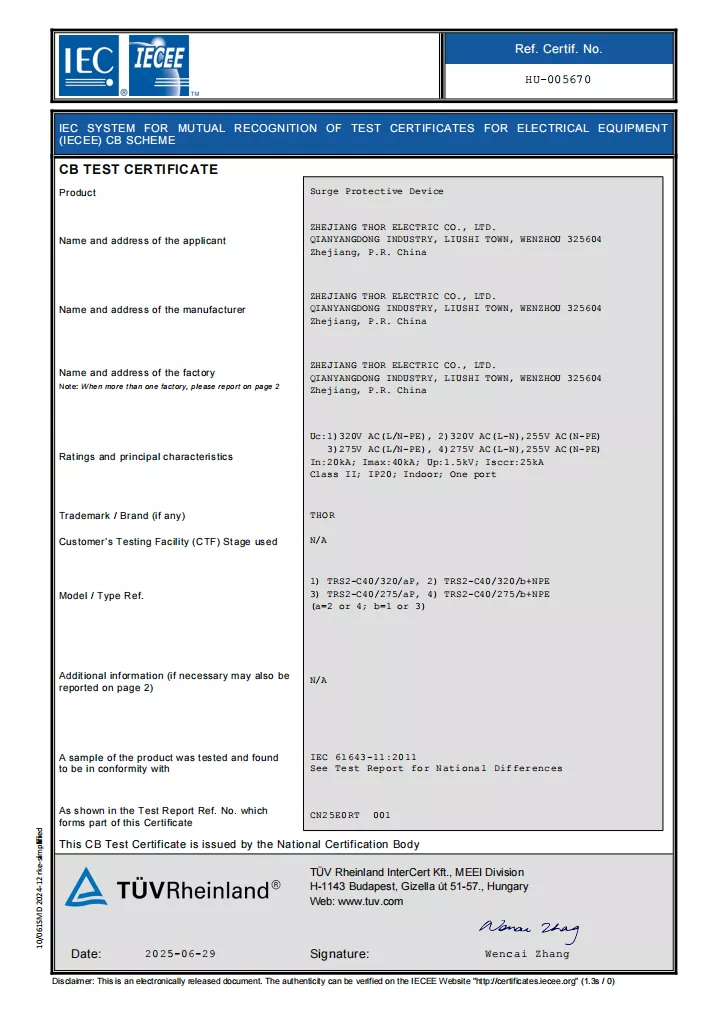
Figure 4 — CB Test Certificate HU-005670 showing the TRS2-C40 scope and associated report number.
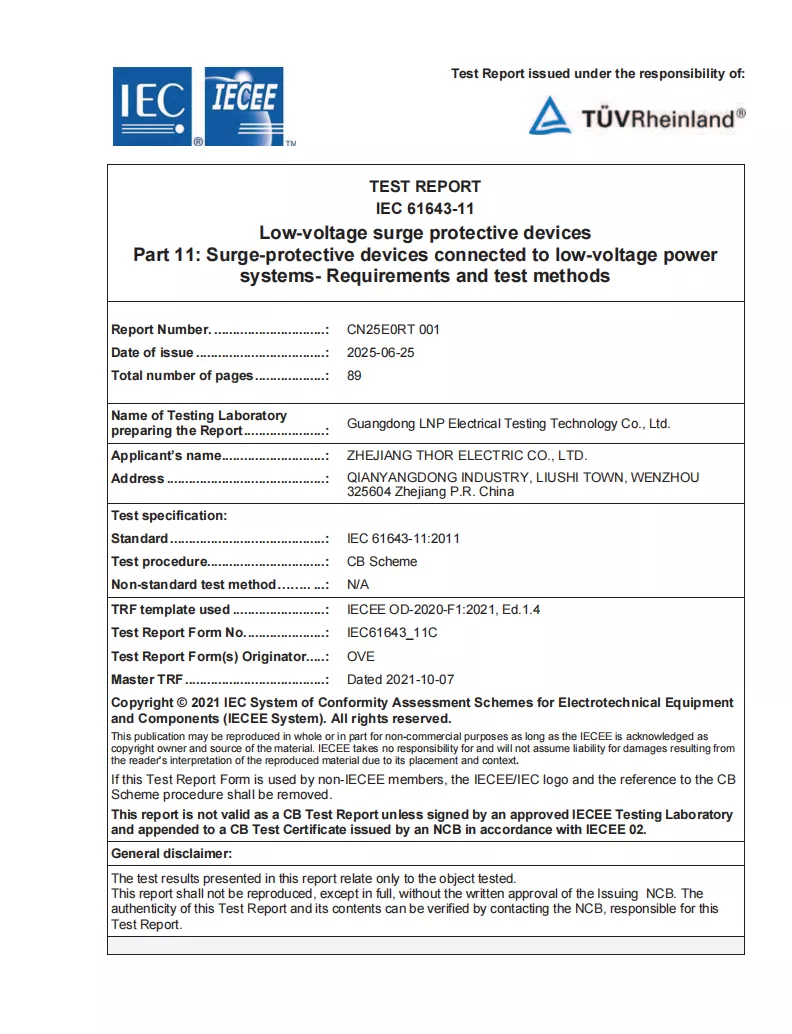
Figure 5 — Cover of associated CB Test Report CN25E0RT 001 under IEC 61643-11.
The European Commission’s CE guidance places responsibility for conformity assessment, technical documentation, the EU Declaration of Conformity and CE marking on the manufacturer. A CE mark or declaration should therefore not be treated as equivalent to third-party TÜV or CB evidence.
The CB Scheme connects a CB Test Certificate with an associated test report and participating national certification bodies. Buyers can use the official IECEE certificate database to check certificate records. National requirements can still add deviations, documents or local approvals, so a CB certificate is not a universal permission slip for every country.
North American projects sit outside Thor’s main IEC-market path. If a specification calls for UL 1449, verify a matching UL record and do not substitute an IEC/TÜV document without written approval from the authority or project party responsible for acceptance.
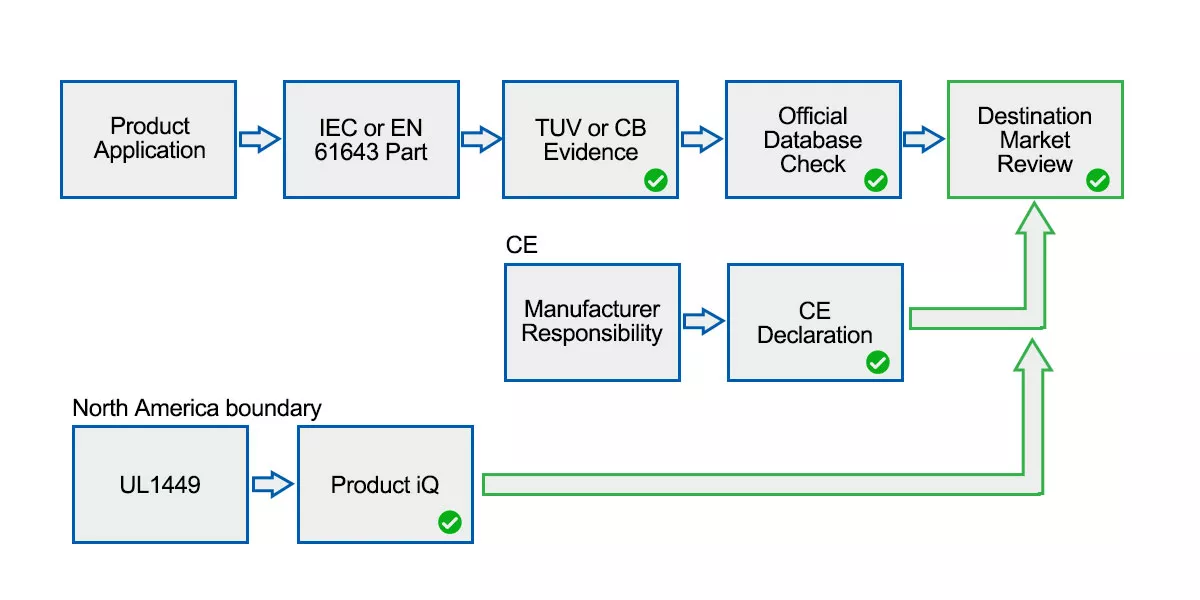
Figure 6 — Document paths for IEC-oriented markets, with UL 1449 shown only as a North American scope boundary.
Verify the certificate in seven checks
Run the same sequence for every supplier. Starting with electrical ratings while ignoring the holder or model scope can waste time on a document that never applied to the quoted product.
- Identify the issuing body and scheme. The name on the PDF should correspond to the certification route being claimed. A test laboratory, certification body and standards publisher have different roles.
- Search the certificate number. Use the issuer’s own database. Check status, revision and any linked scope rather than accepting a search-engine image or supplier-hosted PDF as the final record.
- Match the certificate holder. The legal company on the certificate should have a clear relationship to the product manufacturer. If the seller is different, ask who manufactures the device and who controls the certified design.
- Match the full model. Compare every prefix, suffix and variant. Ask for the annex when the certificate lists a family code but the quotation contains a longer catalogue number.
- Match the standard and SPD Type. An IEC 61643-11 Type 2 document does not establish IEC 61643-31 coverage for a PV SPD or IEC 61643-21 coverage for a signal-line protector.
- Match ratings and configuration. Compare voltage, pole count, protection mode and the discharge ratings printed in the certificate scope with the datasheet and quotation.
- Cross-check the physical product. The sample label, packaging, datasheet, quotation and surge protection device certificate should identify the same product. Record discrepancies before approving artwork, samples or payment.
Figure 7 turns the checks into one path. A mismatch does not always prove that a document is false, but it does stop the buyer from relying on that document until the supplier resolves the mismatch.
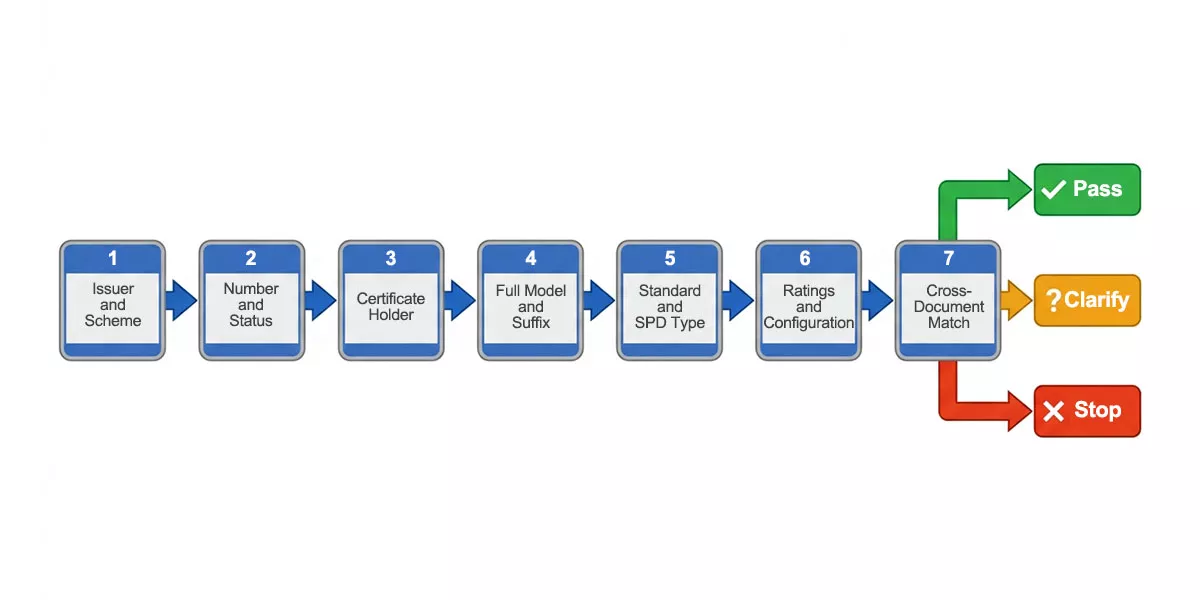
Figure 7 — A seven-check workflow from issuer lookup to the final certificate, datasheet, label and quotation match.
Consider a hypothetical quotation for a 4-pole, 275 V AC Type 2 SPD. The buyer receives a certificate PDF referring to the same series name. The seven checks produce three possible outcomes:
| Finding | Decision | Buyer action |
| Live issuer record covers the full 4-pole model, IEC/EN 61643-11 Type 2 and the quoted voltage | Pass the document check | Continue with sample, commercial and project review |
| Database record shows the series but the visible scope does not list the 4-pole suffix | Clarification needed | Request the complete annex or written scope confirmation from the issuing route |
| Certificate covers a 2-pole model, another voltage or a PV standard | Stop relying on the certificate | Ask for the correct document before approving the product |
The example tests document consistency only. It does not decide whether the SPD is correctly selected for the installation, whether the tender accepts the scheme or whether local market rules have been met.
Red flags in an SPD document package
Document gaps often look ordinary: a missing annex, a shortened model number or a PDF saved years ago. Treat each gap as a question to close, not as immediate proof of fraud.
| Red flag | Why it matters | What to request |
| Certification logo with no document number | The mark cannot be tied to a searchable record | Full certificate and official lookup reference |
| Cropped first page | Holder, scope, annex or status information may be missing | Complete PDF including annexes and revision pages |
| Similar but incomplete model code | The quoted suffix may sit outside the tested family | Written model-scope confirmation |
| Wrong IEC 61643 part | AC, PV/DC and signal SPDs follow different product-standard parts | Certificate for the actual application and model |
| Voltage or pole count absent from scope | A shared enclosure does not establish coverage for every electrical configuration | Scope page that identifies the quoted voltage and configuration |
| Datasheet supplied instead of a certificate | A supplier declaration of ratings is not the requested third-party evidence | The certificate and its database record |
| Certificate holder differs from the claimed manufacturer | The commercial and certified-product relationship is unclear | Manufacturer identity and authorization or supply-chain explanation |
| New OEM label with no marking confirmation | Private labelling can change how the product and responsible company are identified | Written confirmation covering the proposed brand, label and documents |
| Certificate cannot be found in the stated database | The number may be incorrect, replaced, restricted or no longer current | Current record or an explanation from the certification body/supplier |
PDF metadata, image quality and formatting can support a review, but none replaces the issuing body’s record. The strongest package is internally consistent: certificate, report reference, datasheet, product label and quotation point to the same device.
What to request before a sample or bulk order
Ask for documents in the order you need them. Waiting until production is complete to discover that a model suffix or private label is outside the available scope creates a commercial problem that a clearer pre-order review could have prevented.
Before accepting the quotation
Request the full product certificate, datasheet and exact model code. State the destination market and project specification so the supplier can identify the applicable IEC/EN, TÜV, CB, CE or other documentation instead of sending every certificate in its library.
Check the issuing database at this stage. If the certificate refers to a report, ask whether the full report or relevant extracts can be shared and under what conditions. A type-test report belongs to the evaluated product and certification process; it should not be described as a fresh test performed on every production batch.
Before approving the sample
Compare the sample label with the quotation and certificate scope. Photograph the complete label, including the model, voltage, SPD Type and key ratings, so the approval record shows which version was checked.
For an OEM order, send the proposed brand and label artwork early. Ask for written confirmation covering the nameplate, model identity, packaging and the documents that may accompany the private-labelled product. A supplier’s ability to manufacture a custom label does not by itself establish permission to use a certification mark.
Before production and shipment
Agree which order-specific QC records are required. These can include an outgoing-inspection summary, agreed electrical checks, label confirmation or packaging inspection. The exact batch documentation is a commercial and quality-plan requirement, separate from the original surge protection device certificate.
Certificate review is one part of supplier due diligence. Production control, traceability, sample consistency and communication still matter after the document check passes.
FAQ
What certification should a surge protector have?
The required evidence depends on the destination market, product application and project specification. For IEC-oriented projects, start with the applicable IEC/EN 61643 part and check the TÜV, CB or other third-party documents requested by the buyer; North American specifications can require a separate UL 1449 path.
How do I verify a surge protection device certificate?
Search the certificate number in the issuing body’s official database, then match the holder, complete model, standard, SPD Type, voltage and configuration to the quotation, datasheet and product label. Ask for the scope annex when the database or first page lists only a model family.
How do I know if a surge protector is UL certified?
Search UL Product iQ using the file, certificate, company or product information and compare the live listing with the exact device. A UL logo in a catalogue or on a sales page is not a substitute for the matching official record.
What is the difference between a CB Test Certificate and a CB Test Report?
The CB Test Certificate identifies the product and certification scope accepted by the issuing National Certification Body. The associated CB Test Report contains the detailed test record. Buyers often need the pair when a destination-market certification body reviews the product, subject to that market’s national differences and other requirements.
Can one certificate cover several SPD models?
Yes, when the certificate scope or annex explicitly lists a model family and its permitted variants. A shared enclosure or similar catalogue name is not enough; the quoted suffix, voltage, pole configuration and SPD Type must fall within the stated scope.
Discuss your SPD document requirements
Thor Electric supports certificate documents, TÜV/CB documentation and OEM marking confirmation for applicable SPD models. Include the destination market, system voltage, SPD Type, pole configuration and quantity so the team can match the quotation to the available documents; referenced test reports and batch QC records are confirmed per request. Contact Thor Electric to review the document scope before sample or bulk-order approval.