
Most lists of SPD manufacturers put ten companies in numbered order and never say what the number measures. Ours does not rank them. The ten SPD manufacturers below are grouped by a common starting point for procurement: five global automation brands often bought inside a wider switchgear package, and five companies selected here for substantial surge or lightning-protection portfolios. Shortlist from the table, then verify whichever names survive against the test report covering the exact model you are quoting.
Top 10 SPD manufacturers at a glance
A blank cell means the official pages checked on 16 September 2026 do not publish that range or service. It is not a statement that the company cannot supply it. The AC column uses IEC Type 1, Type 2 and Type 3 labels where the company’s official material publishes them. That keeps the comparison of these SPD manufacturers tied to public evidence.
| Company | HQ | Published AC range | DC / PV | Signal / data |
| Global automation brands | ||||
| Schneider Electric | Rueil-Malmaison, France | Type 1 / 1+2 / 2 (Acti9) | Acti9 iPRD-DC-PV Type 2 | Acti9 iPRC, iPRI and iPRE; Surgelogic Signal Line |
| ABB | Zurich, Switzerland | Type 1 / 2 (OVR) | OVR PV to 1500 V DC; OVR PV T1-T2 | OVR data line range |
| Siemens | Munich, Germany | Type 1 / 1+2 / 2 / 3 (5SD7) | 5SD7 PV protection | 5SD7 measuring and control signal circuits |
| Eaton | Dublin, Ireland | Type 1 / 1+2 / 2; SPD Series (AC) | SPPVR Type 1+2 / 2, 600–1500 V DC | NSP terminal block, RJ45 and BNC range |
| Phoenix Contact | Blomberg, Germany | Type 1 / 1+2 / 2 (TRABTECH) | PV arresters for 1000 V and 1500 V DC | TERMITRAB and other MCR, data and signal ranges |
| Surge-protection specialists | ||||
| DEHN | Neumarkt, Germany | Type 1+2+3 / 1+2 / 2 | Red/Line to 1500 V DC | Data centre and signal ranges |
| CITEL | Paris, France | Type 1+2+3 / 1+2 / 2 / 2+3 | PV Type 1 / 1+2 / 2 / 2+3 | Telecom, Dataline, Radiocommunication |
| OBO Bettermann | Menden, Germany | Type 1 / 1+2 / 2 | PV range | ND-CAT6 data, Type 2+3, to 1 Gbit |
| Mersen | France | Type 1 / 1+2 / 2 / 2+3 | STPT2 8YPV, Type 2 | STS Ethernet, RF, PLC and RS485 |
| Thor Electric | Yueqing, Zhejiang, China | Type 1 / 1+2 / 2 | TRS3 for PV and DC | TRSS-RJ45, TRSS-485, TRSS-DB and TRSW |
Two kinds of SPD manufacturers, and why the difference matters
The split above is a procurement starting point, not a quality grade. The global automation brands can place the SPD beside breakers, contactors, terminals and other panel parts in the same catalogue. That route can simplify approved-vendor lists and panel purchasing when the project already specifies the wider brand.
The second group is selected here because each company publishes a substantial surge or lightning-protection portfolio. That can suit a buyer comparing application coverage, replacement modules, certificate scope or an OEM route independently from the switchgear brand. Mersen and OBO Bettermann also operate broader electrical businesses, so the grouping describes the portfolio being bought rather than the whole company. A panel builder standardising across fifty boards and a solar EPC sourcing 1500 V DC protection do not have the same answer. The criteria are set out in our guide on how to choose an SPD manufacturer.
The ten SPD manufacturers in detail
The last line of each entry is our reading of the published portfolio, not a claim issued by the company.
Schneider Electric
Rueil-Malmaison, France. Surge protection sits in the Acti9 modular range: iPRD at Type 2, and iPRF1 12.5r, PRD1 25r and PRD1 Master at Type 1 with a Type 2 rating as well. Acti9 iPRD-DC-PV covers photovoltaic circuits, while iPRC, iPRI and iPRE cover telecom, control and Ethernet lines. Suits panel builders already standardised on Acti9.
ABB
Zurich, Switzerland. OVR covers Type 1 and Type 2 on AC, OVR PV reaches 1500 V DC with a T1-T2 option for DC combiners, and an OVR data line range sits alongside. One of the few global brands publishing power and data together.
Siemens
Munich, Germany. SENTRON 5SD7 covers Type 1, Type 1+2, Type 2, and Type 1/2/3 devices for 40 mm busbar systems. Siemens also publishes 5SD7 devices for PV protection and for measuring and control signal circuits. Most of the lightning arresters carry a remote signalling contact as standard, which counts on sites where SPD status reports into an existing control layer.
Eaton
Eaton Corporation plc, Dublin, Ireland. The North American SPD Series covers 120 V to 600 V AC at 50 kA to 400 kA in NEMA 1, 4 and 4X enclosures. Eaton’s IEC portfolio also includes Type 1, Type 1+2 and Type 2 AC devices, SPPVR photovoltaic devices from 600 V to 1500 V DC, and NSP products for signal lines. Check the regional catalogue because the North American and IEC ranges use different product families.
Phoenix Contact
Blomberg, Germany. TRABTECH covers Type 1, Type 2 and Type 1+2, with DIN rail PV arresters for 1000 V DC and 1500 V DC. TERMITRAB and the wider signal portfolio cover measurement, control and data interfaces. Protection sits beside the terminal blocks, so a panel builder buys wiring and protection from one catalogue.
DEHN
Neumarkt in der Oberpfalz, Germany. Red/Line covers systems to 1000 V AC and 1500 V DC. DEHNventil combines Type 1, Type 2 and Type 3; DEHNshield is a Type 1+2 spark gap device, Up at or below 1.5 kV and Iimp of 37.5 to 50 kA (10/350) by model; DEHNguard is the modular Type 2 line. DEHN also publishes lightning protection and earthing hardware, which counts when SPD selection has to follow an external lightning protection system.
CITEL
Paris, France. The range is organised both by IEC type and by application. AC products cover Type 1+2+3, Type 1+2, Type 2 and Type 2+3; photovoltaic products cover Type 1 through Type 2+3. Separate LED, Telecom, Dataline and Radiocommunication ranges put CITEL on lighting, industrial-network and broadcast projects.
OBO Bettermann
Menden, Germany. MCF Compact 75/200 at Type 1, V50 at Type 1+2, V20 and V10 Compact 2.0 at Type 2, with the V20 rated 40 kA (8/20) per pole. Data protection goes to the ND-CAT6 class, Type 2+3, for networks to 1 Gbit, and there is a published range for potentially explosive atmospheres.
Mersen
A French group. Surge-Trap covers Type 1, Type 1+2, Type 2 and Type 2+3, 12 V up to 690 V and above, across TN-S, TT, TN-C and IT. STPT2 8YPV covers photovoltaic circuits, while the STS range covers Ethernet, RF, PLC and RS485 signal lines. Mersen also sells surge-protection components to equipment builders.
Thor Electric
Yueqing, Zhejiang, China. AC Type 1 runs through the TRS-A graphite gap series, Type 2 through TRS-B/C/D, TRS2, TRS4 and TRS7, and Type 1+2 through TRS5 and TRS8. TRS3 covers PV and DC.
The signal side runs to RJ45, RS485, DB serial and coaxial. OEM, ODM and private-label production covers all four lines.
Component suppliers and finished SPD manufacturers are different roles
A varistor is not a surge protective device. The metal oxide varistor does the clamping and a gas discharge tube carries the high-energy work in many designs, but the finished SPD is the assembly around them, including the type testing that turns a component specification into a declared Iimp or Imax.
A few companies work in both roles. Mersen publishes finished Surge-Trap SPDs and also supplies surge-protection components to equipment builders; Littelfuse is better known on the component side. The question is not which label a company wears, but which of its two catalogues you are buying from, because the type test that protects you exists at the finished-device level.
How to check a manufacturer’s claim yourself
Every one of the SPD manufacturers on this page says it meets the standards. So does every company that is not on this page. The claim carries no information until you have followed it back to a document, and the sequence takes about twenty minutes per supplier.
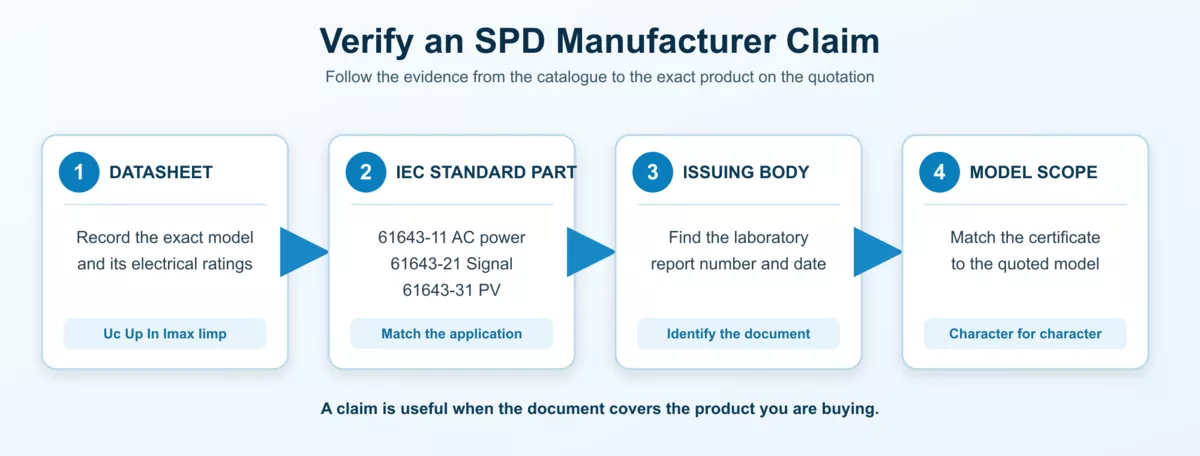
Figure 1 — The four-step path from a catalogue claim to a certificate that covers the model you are buying.
- Start from the datasheet, not the brochure. You want Uc, Up, In, Imax, and Iimp for anything claiming Type 1. A kA number with no waveform behind it tells you nothing: 40 kA at 8/20 µs and 40 kA at 10/350 µs are different tests and different products.
- Ask which part of IEC 61643 the product was tested to. Low-voltage power sits under 61643-11, telecom and signalling under 61643-21, photovoltaic under 61643-31. A supplier quoting 61643-11 for a PV string device is reusing a report that does not apply.
- Get the test report and read who issued it. A report from an accredited laboratory names the laboratory, the report number and the date. A self-declaration names nobody. Both get described in a catalogue as compliance.
- Check that the certificate scope covers your model. This is the decisive scope check. A certificate issued against one model in a family does not automatically extend to the 320 V variant, the four-pole version or the one with the remote contact. Match the model code on the certificate to the model code on your quotation, character for character.
Run that on three shortlisted suppliers and the list usually sorts itself out without anyone arguing about brand reputation.
Where our own range fits
We manufacture surge protection and nothing else, from Yueqing in Zhejiang, China, which places us with the specialist SPD manufacturers above and gives us the trade-offs that come with that position.
Compare Thor’s AC surge protection devices, DC surge protection devices and signal surge protection devices by application before selecting an individual model.
| Line | Series | Coverage |
| AC Type 1 | TRS-A | Graphite gap, Iimp 15 to 50 kA (10/350), Up 2.0 to 2.5 kV |
| AC Type 2 | TRS-B/C/D, TRS2, TRS4, TRS7 | MOV, Imax 10 to 150 kA (8/20), 230 V and 380 V systems |
| AC Type 1+2 | TRS5, TRS8 | Combined arresters, MOV and MOV with GDT, Up 1.3 to 1.5 kV |
| DC and PV | TRS3 | To 1500 V DC Uocstc for PV, plus 24 V to 110 V DC variants |
| Signal | TRSS-RJ45, TRSS-485, TRSS-DB, TRSW | Ethernet and PoE, RS485, DB serial, coaxial to 2.5 GHz |
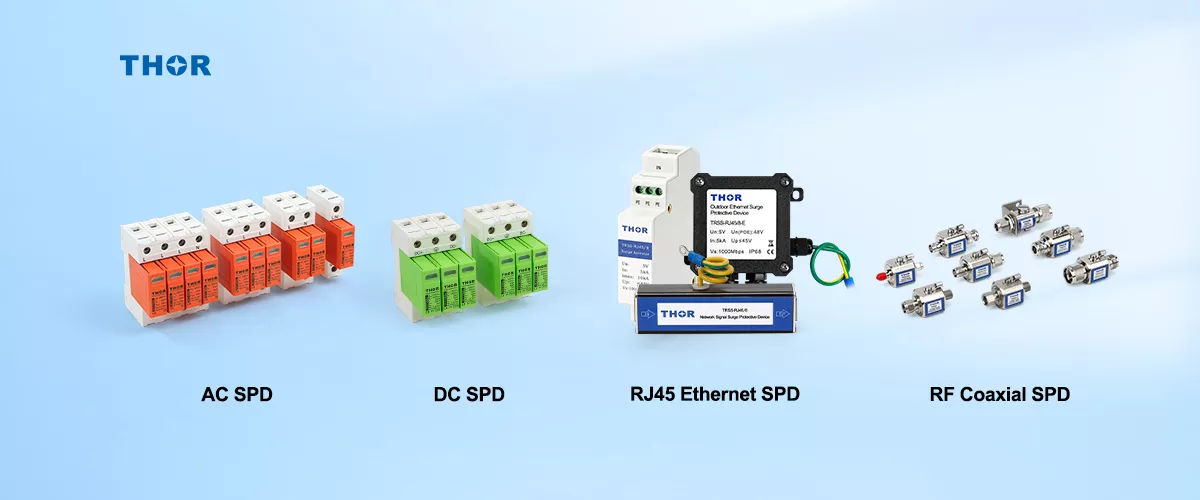
Figure 2 — Thor SPD product range for AC, DC, Ethernet and RF coaxial protection.
The plug-in AC and PV families use replaceable modules, so a failed module comes out without rewiring the board. Named variants in the product reference include remote signalling. Testing references EN and IEC 61643-11 for AC, 61643-21 for signal and 61643-31 for PV, by covered family. Thor’s document library includes TUV and CB certificates for covered models, CE and RoHS conformity documents, and ISO management-system records. There is no UL listing, so the range is specified into IEC markets.
Minimum order quantity is one unit, standard catalogue items ship from stock, and some configurations are made to order. Custom Uc values, housings, packaging and private-label branding are part of the standard OEM and private-label route, with terms confirmed against the enquiry.
What changes the price
Quotes from two SPD manufacturers with the same headline kA rating can differ by several times. The gap sits in certification scope, because a third-party report covering every model in a family costs more to maintain than one report stretched across a catalogue; in construction, where thermal disconnector design and MOV grade change end-of-life behaviour; and in configuration, since non-standard Uc, pole counts and enclosure ratings pull the product off the standard run. Comparing on the kA number alone is how buyers pay for a certificate that does not cover the model in the box.
FAQ
Who are the manufacturers of surge arresters?
It depends which product you mean. In low-voltage installations, surge arrester and SPD describe the same device, and the SPD manufacturers listed above are the main suppliers. In high-voltage transmission and distribution, a surge arrester is a different product built to a different standard family, served largely by the grid divisions of the big power companies.
What company makes the best surge protectors?
No company holds that position across every application. The device that is correct for a 1500 V DC combiner box is wrong for an RS485 line, and the supplier with the best 230 V Type 2 range may publish nothing for coaxial feeds. Decide the protection requirement first, then shortlist the SPD manufacturers whose published range covers it.
What is better than a surge protector?
Nothing replaces it, but one device on its own is rarely the right design. Coordinated protection puts a Type 1 or Type 1+2 device at the service entrance and Type 2 devices at the distribution boards, so no single unit absorbs the whole event. A UPS solves a different problem.
Get a quote against your actual installation
If you are shortlisting SPD manufacturers and want us on the list, send the four things needed to quote properly: system voltage and earthing arrangement, which protection levels the installation needs, the certification scope your destination market requires, and whether the product carries your brand or ours. We will come back with model numbers and the test reports behind them, so you can run the verification above on us before anything is ordered. Talk to our engineers.