
An LED street light rarely reaches end of life at its LEDs. The driver goes first, and a surge is one of the quickest routes there. Surge protection for LED street lights is a sizing job, not a shopping job: the device has to hold off the pole’s continuous voltage without conducting, divert an 8/20 µs impulse without failing, and clamp low enough that the driver never sees a damaging transient.
Four parameters decide it: Uc, In, Imax and Up. What follows is what each one means at a pole, where the device belongs on the circuit, and the maintenance choice that comes with wiring it in parallel.
Do LED street lights need surge protection?
Yes, in most outdoor installations. A pole-mounted luminaire sits on an exposed circuit: an elevated structure at the end of a long cable run, often the tallest object on that stretch of road. An SPD across the driver input is a small part to fit, while replacing a failed pole-top fixture needs an access platform and traffic management.
The argument usually made is that LED drivers are more delicate than the magnetic ballasts they replaced. True enough, and also the least useful way to think about it. Exposure decides the case. A lighting circuit runs for hundreds of metres between poles, the columns are often earthed, and the whole run behaves as a loop that couples the magnetic field of a nearby strike. The driver at the top of the pole is usually the most sensitive thing connected to that loop.
Access decides the rest. Changing a dead fixture over a live road means a platform, traffic management and crew hours booked in advance. An SPD is a small part fitted once, at the bench or during installation.
There is a real exception. A short run fed from inside a building, on a supply already protected upstream, with no exposed cable, is a different risk. Most street lighting is not that.
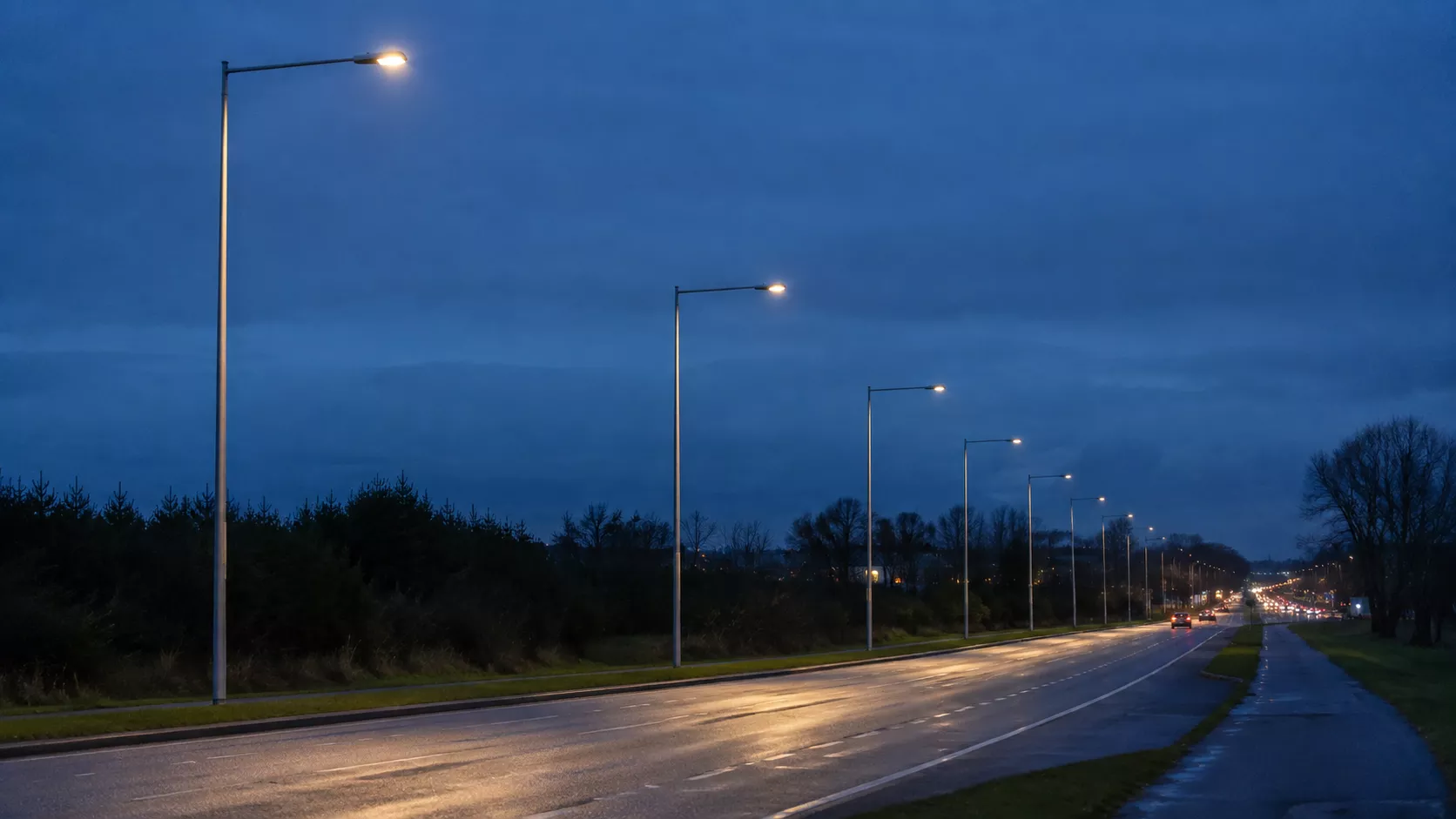
Figure 1 — Roadway lighting on a run of pole-mounted LED luminaires at dusk, the exposure case that decides whether an SPD is worth fitting.
How a surge reaches an LED driver
Three routes reach the driver, and they are not equally common.
A nearby strike is the violent one. Current flowing in the ground lifts the potential of the pole’s earth connection while the supply conductors stay near their own reference, and the difference appears across the driver input.
An induced transient travels the feeder. A strike anywhere along a lighting circuit couples into the cable and propagates both ways, so a fixture several poles from the event still sees a fast overvoltage.
Switching does the quiet damage. Lighting contactors operate every dusk and every dawn, capacitor banks switch, the network reconfigures itself. Each event is small. None of them announces itself.
That last route explains why street lights fail in ways nobody can pin on a storm. One large surge punches through the driver’s input stage and the light goes out that night. Repeated smaller surges do something less visible: each impulse heats the protective element slightly and its clamping voltage drifts, the same ageing mechanism behind most SPD wear-out. The fixture keeps working until the day it does not.
Figure 2 shows where each route enters the circuit, which is the map the installation section below depends on.
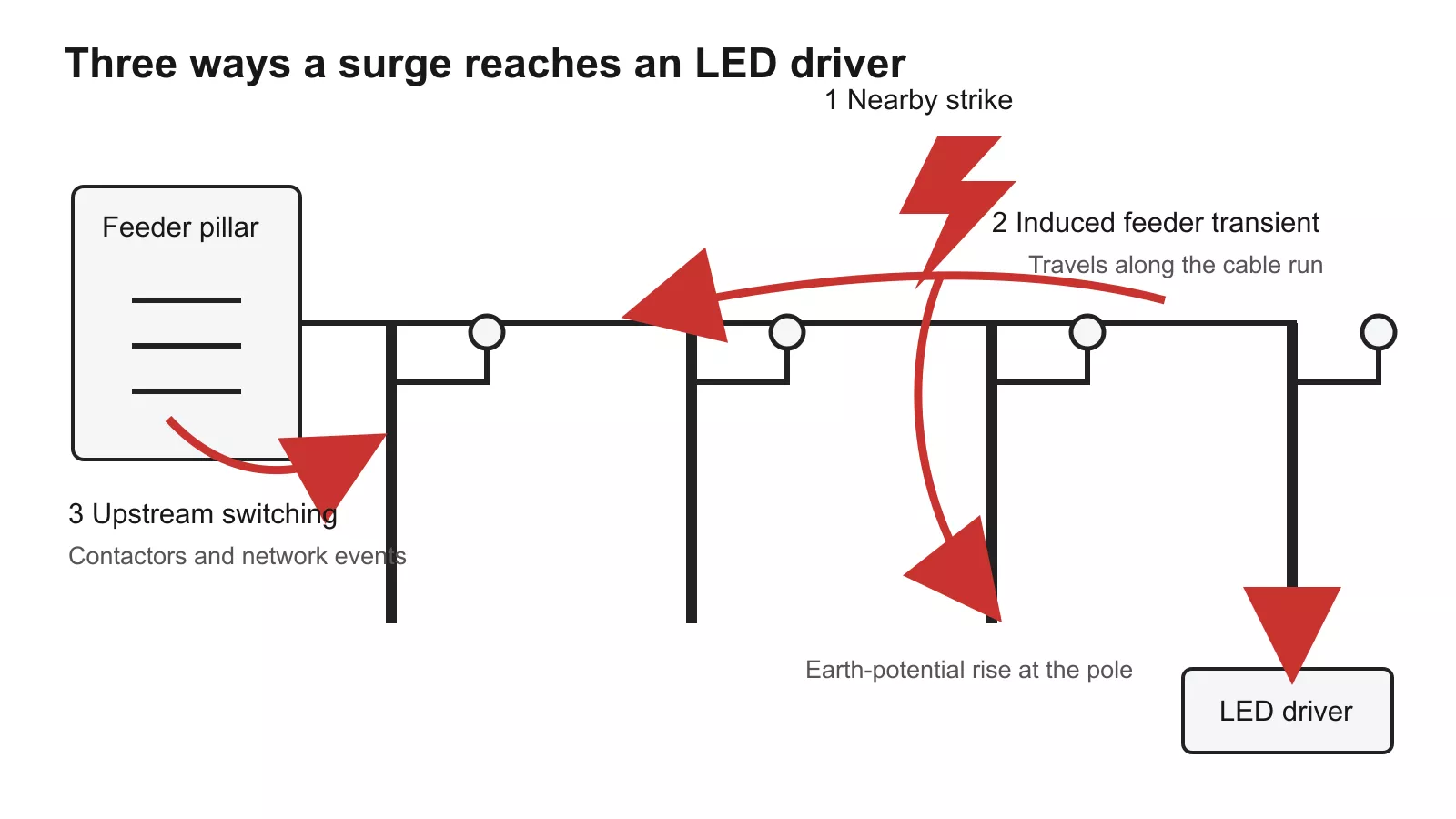
Figure 2 — Three surge entry routes on a street lighting circuit: earth potential rise at the pole from a nearby strike, an induced transient travelling the feeder, and switching transients from upstream.
The four numbers that decide the device
Almost every page written about surge protection for LED street lights explains the damage and stops there. Four parameters do the actual selection work, and each has a specific failure behind it.
- Uc, the maximum continuous operating voltage the device can sit across indefinitely. Set it too close to the system’s normal upper limit and the SPD starts conducting during ordinary voltage excursions, heating itself until it disconnects. A 390 V AC Uc leaves real headroom on any nominal supply in the 110–277 V AC band.
- In, the nominal discharge current: an 8/20 µs impulse the device is tested to take repeatedly and still work afterwards. Routine duty.
- Imax, the maximum discharge current: a single 8/20 µs impulse the device survives once. A large Imax on its own is a weak selling point, because it says the SPD will not come apart, not that the driver will live.
- Up, the voltage protection level, which is the let-through voltage the driver actually sees. Everything else on the datasheet is academic if this number sits above what the driver can withstand.
Driver manufacturers state that withstand as a surge immunity test level in kV, tested under IEC 61000-4-5. SPD manufacturers state In and Imax in kA of 8/20 µs discharge current under IEC 61643-11. Those are different quantities from different test set-ups. The first check is Up against the driver’s declared immunity, compared in the same protection mode, because a device clamping line to earth and one clamping line to neutral are answering different questions. Two things then move the real figure: the voltage the connecting leads add, covered below, and how this stage sits under whatever protects the feeder further upstream. For the wider parameter set, see how to read a surge protection device datasheet.
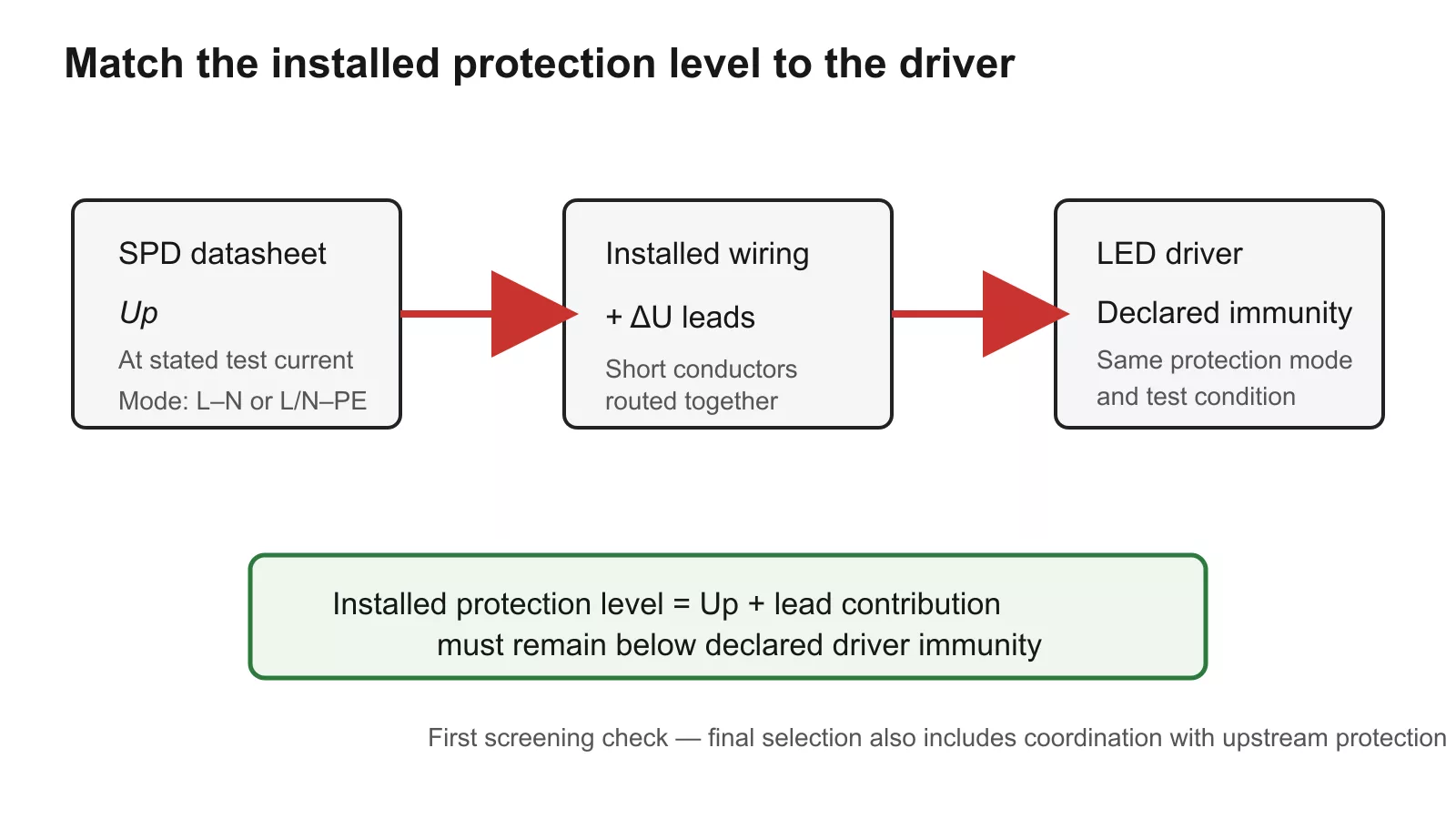
Figure 3 — The first check between an SPD datasheet and an LED driver datasheet: Up must sit below the driver’s declared surge immunity in the same protection mode, with margin left for the voltage the connecting leads add.
Two more parameters matter at a pole. The ingress rating has to suit where the device physically sits: a sealed IP67 module for a luminaire or a column base that takes water, a lower rating only where the SPD lives inside an enclosure already rated for the environment. And the response has to be quick, because there is no useful length of cable between an SPD at the driver input and the driver itself to slow the wavefront.
Thor’s TRSS-LED is built for exactly that position: a sealed IP67 module with L, N and PE flying leads that lands across the driver input inside the luminaire or in the pole base. It clamps in common mode and differential mode, so it covers a surge riding the line against earth as well as one appearing between live conductors.
| Parameter | TRSS-LED |
| Un | 110–277 V AC |
| Uc | 390 V AC |
| In (8/20 µs) | 5 kA |
| Imax (8/20 µs) | 10 kA |
| Up | 1.1 kV |
| Response time | < 25 ns |
| Enclosure | IP67, ABS765A, 81 × 37.6 × 13.5 mm, 57 g |
| Leads | 1.5 mm² flexible, L / N / PE |
| Operating temperature | −40 °C to +85 °C |
| Test standards, as declared in the catalogue | EN 61643-11:2012, IEC 61643-11:2011 |
| Fault indicator | Optional |
We hold the Uc at 390 V AC across the whole 110–277 V band rather than splitting the line into voltage-specific part numbers, which is what keeps a single item code usable on a project that crosses supply standards.
Those are the editions the TRSS-LED catalogue names. IEC has since published a 2025 edition of IEC 61643-11, so for a project that specifies an edition, ask for the certificate covering the model and the edition rather than reading the standard number off a datasheet.
A luminaire SPD is end-point protection. It sits at the far end of the installation, downstream of whatever protects the feeder pillar, and it is sized for what survives that far, not for the energy of a strike at the service entrance. For how the stages divide up across an installation, see Type 1, Type 2 and Type 3 SPDs.
Why a US rating and an IEC rating are not interchangeable
Anyone comparing a US roadway catalogue against an IEC datasheet hits this within five minutes, and the confusion almost always comes from stacking three separate standards into one number.
ANSI C136.2 sets transient immunity requirements for roadway and area lighting equipment: what the luminaire and its control devices are expected to withstand. UL 1449 is the standard an SPD itself is certified against for the US market, with its own type classifications and performance markings. IEC 61643-11 is the international test standard for low-voltage SPDs, and it is where In and Imax come from as 8/20 µs discharge currents.
| Standard | What it covers | What is under test |
| ANSI C136.2 | Transient immunity for roadway and area lighting equipment | The luminaire and its control devices |
| UL 1449 | US certification and performance requirements for SPDs | The SPD |
| IEC 61643-11 | International test methods and ratings for low-voltage SPDs | The SPD |
The practical consequence is that none of the three converts into another. A kV immunity level quoted for a luminaire is not a kA rating for an SPD, and a US listing is not an IEC test result. Every figure in this article comes from the IEC side, so on a project written around a US framework, ask for the certificate that names the model and the standard it was tested against.
Where the SPD goes on the pole
Three positions are possible, and they protect different things.
At the feeder pillar or lighting cabinet, an SPD clamps what arrives from the incoming supply and protects the switchgear in that cabinet. It does little about a transient induced on the run beyond it, which is most of the circuit.
At the pole base compartment, the device protects that pole’s luminaire and sits where a technician can reach it at ground level with the column door open.
At the driver input inside the luminaire, protection is as close to the equipment as it gets and the connecting leads are as short as they will ever be. That is the position TRSS-LED is built for.
Lead length is the part people get wrong. The voltage the driver sees is Up plus whatever the connecting conductors add, and a fast wavefront develops real voltage across even a short loop of wire. Keep the leads short, keep them together, and do not route protected conductors alongside unprotected ones.
Earthing sets the ceiling on part of it. Common-mode diversion sends current to earth, so that path is only as good as the pole’s earth connection and the bonding back at the pillar. Differential-mode clamping works between live conductors and does not lean on the earth path in the same way, which matters where the column is unearthed or the luminaire is Class II. An exposed pole normally sits in what standard practice calls LPZ 0, the zone with no shielding at all, although the boundary follows the lightning protection design for the scheme rather than the pole on its own.
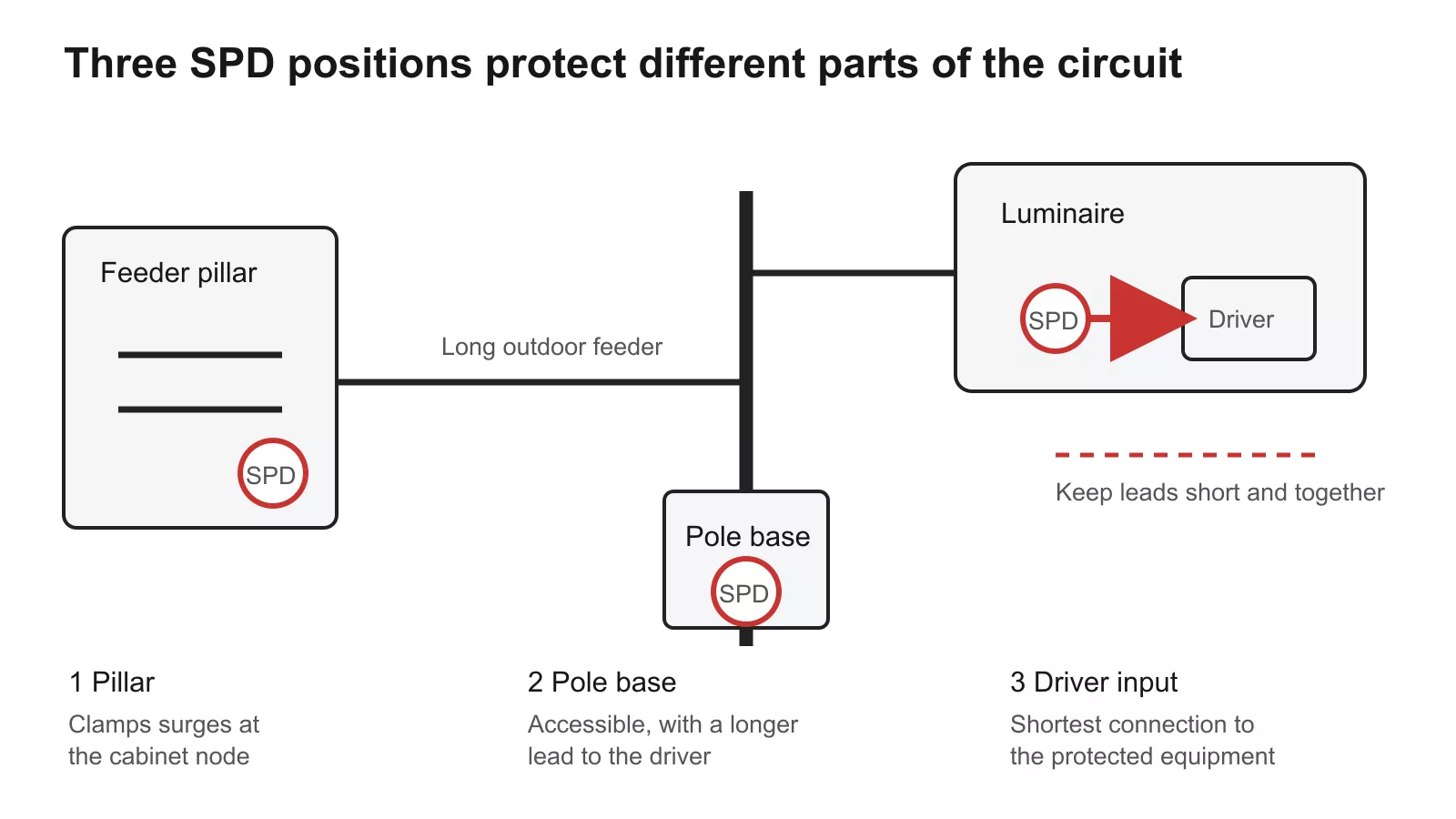
Figure 4 — Three candidate SPD positions on a street lighting circuit, and what each one actually protects: feeder pillar, pole base compartment, and driver input inside the luminaire.
Parallel or series, and what happens when the SPD wears out
Connection topology is the strongest objection raised against luminaire SPDs, and it deserves a straight answer rather than a sales one.
A series SPD sits in the supply path. When it reaches end of life it opens, the luminaire goes dark, and somebody raises a ticket. The failure is loud, and the fixture is never left running unprotected. Signify’s lighting documentation argues for series connection outdoors on exactly that basis.
A parallel SPD sits across the supply. Where the device is built to disconnect its protective element at end of life, the luminaire keeps working and the light stays on while the protection is gone. Nobody notices until the next surge finishes the driver.
TRSS-LED is a parallel device, so the topology side of that trade-off applies to it. The catalogue records the connection and an optional fault indicator; it does not describe the disconnection behaviour or what the indicator reports, and neither should be assumed from the connection type alone. Ask for both against the model you are quoting.
What the decision comes down to on site is whether the failure announces itself. Specify the indicator, or write the SPD into the maintenance plan and inspect it at the same visit as relamping or luminaire cleaning. A parallel SPD that nobody inspects is protection you have already lost and not yet noticed.
Figure 5 shows both topologies in their post-failure state, which is the only state where the difference matters. For what to check during that visit, see SPD inspection and replacement.
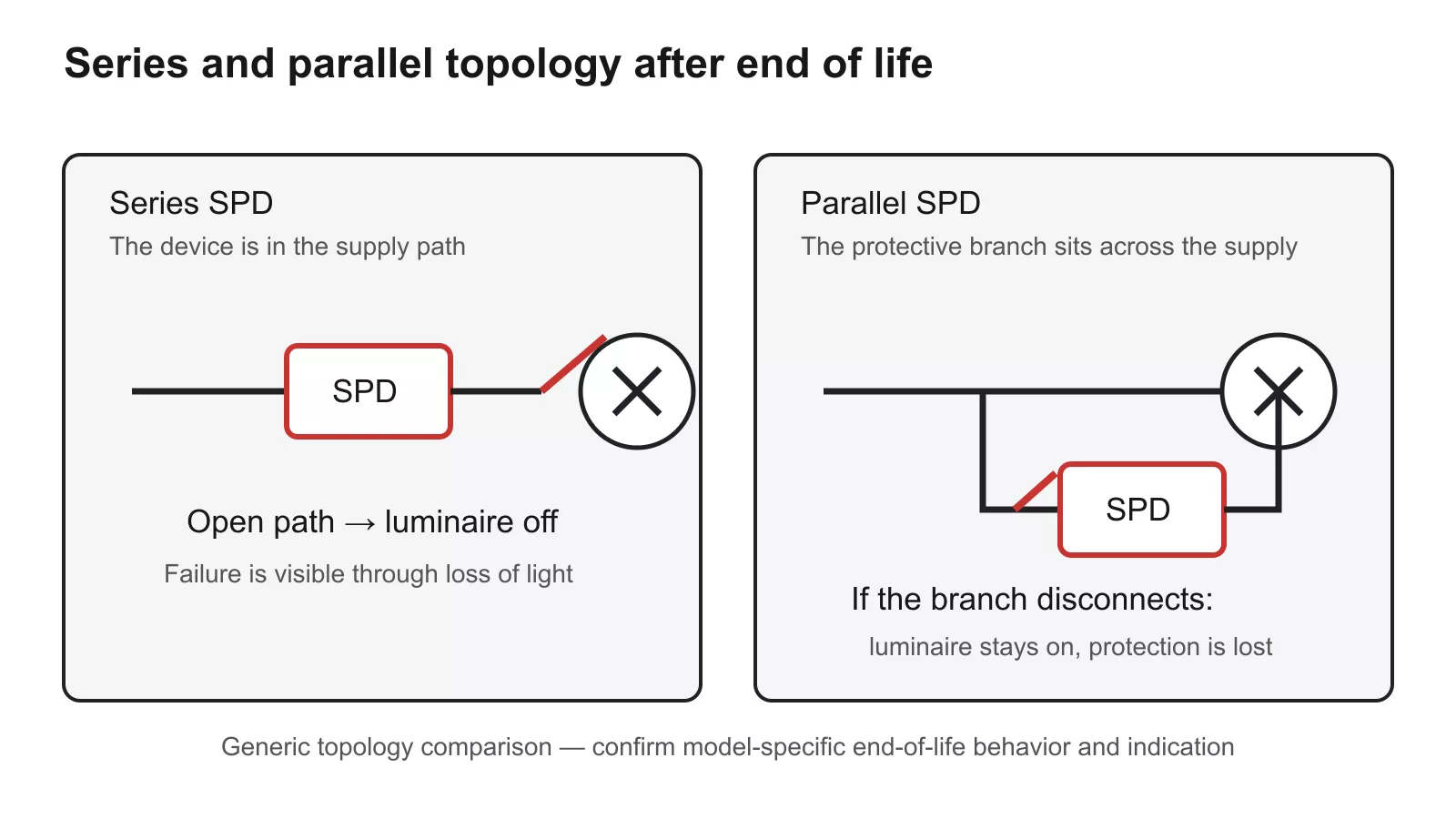
Figure 5 — The topology trade-off once an SPD reaches end of life: a series device in the supply path takes the light out, while a parallel device that disconnects its protective element leaves the luminaire lit and unprotected.
What an SPD will not do for a street light
Three questions about surge protection for LED street lights come up often enough to be worth answering plainly.
It will not stop flicker. Flicker comes from the driver, the dimming interface or the supply voltage itself, and an SPD sitting idle at normal operating voltage has no path to influence any of them. A luminaire that flickers has a driver or a supply problem, and fitting surge protection changes nothing about it.
It will not regulate voltage. A sustained overvoltage is a different condition from a transient: it lasts, and an SPD asked to hold it heats up and disconnects. That is the device protecting itself, not protecting the installation.
It will not survive a direct strike to the luminaire. Nothing mounted at that position is rated for full lightning current, and protecting against a direct strike is a structural lightning protection question settled when the lighting scheme is designed.
How to specify surge protection for LED street lights
Eight things to settle before the purchase order goes out:
- System voltage, and the Uc that leaves headroom above its normal upper limit.
- Exposure of the route: length of run, overhead or buried, local lightning density.
- The driver’s declared surge immunity, and whether Up sits below it with margin.
- Mounting position: driver input, pole base or feeder pillar, and which of them you are actually protecting.
- Lead length and routing at that position.
- IP rating for where the device physically sits, not for where the luminaire sits.
- Connection type, and the maintenance consequence that comes with it.
- The test standard printed on the datasheet, and a certificate naming the model you are buying.
Item 8 is the one that gets skipped. A datasheet naming EN 61643-11:2012 is a claim; a certificate naming the model, the standard and the issuing body is the evidence, and buyers should ask for the second before ordering.
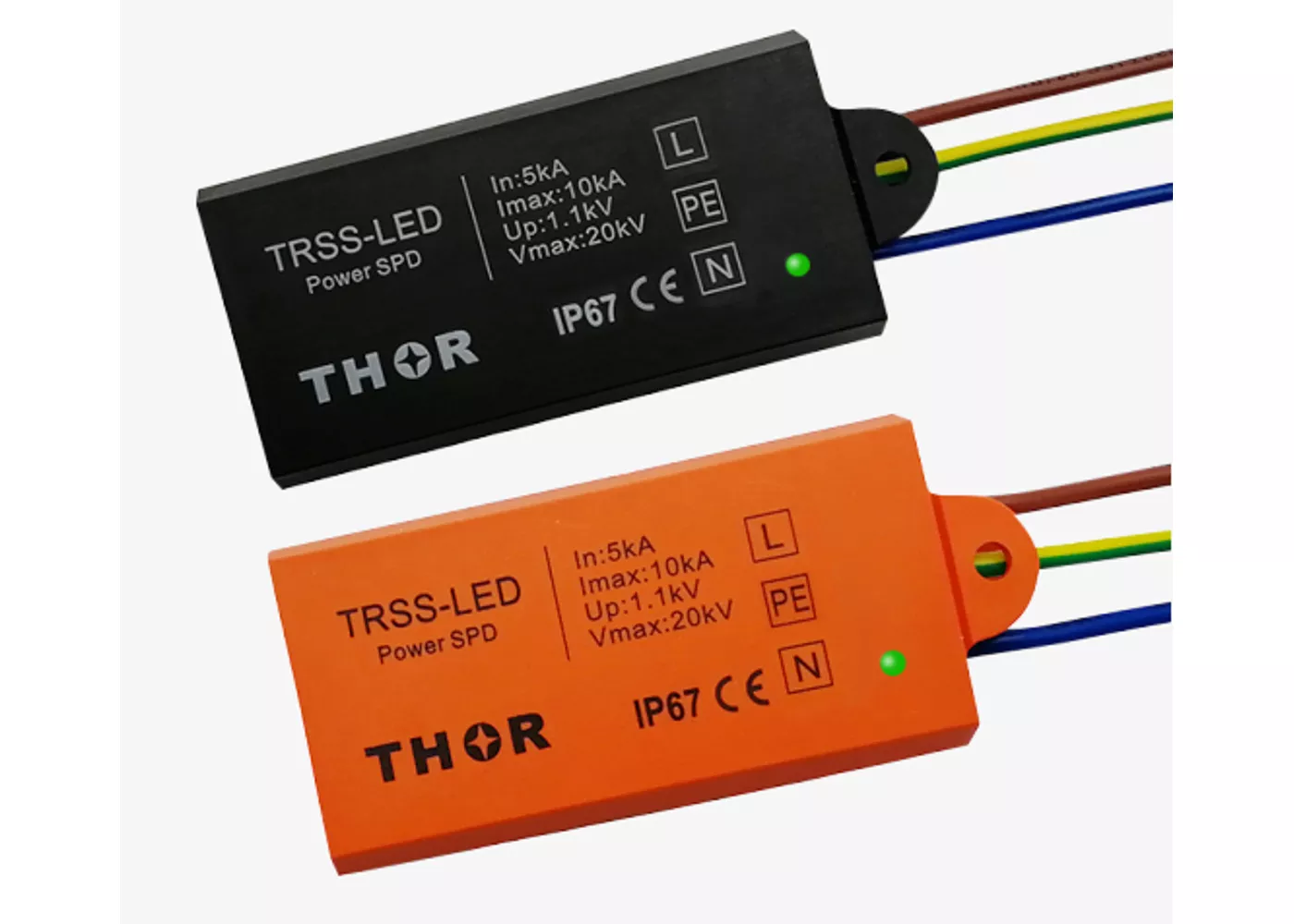
Figure 6 — Thor TRSS-LED street lighting SPD: sealed IP67 module with L, N and PE flying leads, wired in parallel across the LED driver input.
FAQ
Do LED street lights need surge protection?
Yes, for any pole-mounted luminaire on an outdoor feeder. The circuit is elevated, earthed at every pole and long enough to couple energy from a nearby strike, and the driver is the most sensitive component connected to it. Surge protection for LED street lights is a small part fitted once, against a replacement that needs an access platform and traffic management.
Can a power surge damage an LED driver?
Yes, in two different ways. A single large surge breaks down the driver’s input stage outright and the light goes out that night. Repeated smaller surges degrade the protective components inside the driver over months, so the eventual failure looks like ordinary wear instead of a lightning event.
Will a surge protector stop my street lights from flickering?
No. Flicker comes from the driver, the dimming control or the supply voltage, and an SPD does nothing at normal operating voltage. If lights flicker, look at the driver and the incoming supply before considering surge protection.
How often should a street light SPD be replaced?
There is no universal interval, because replacement depends on how much surge energy the device has already absorbed. The practical approach is to inspect the SPD at the same visit as relamping or cleaning, replace it when a fitted fault indicator has operated, and treat any luminaire that has lost a driver to a surge as a device due for replacement.
What IP rating does a street light SPD need?
Choose the rating for where the device physically sits, not for where the luminaire sits. A position open to weather, or a column base that takes water, needs a sealed device; an SPD inside a cabinet already rated for the environment does not. TRSS-LED is sealed to IP67 and rated −40 °C to +85 °C for the exposed positions.
Thor Electric surge protection devices
Thor Electric manufactures low-voltage surge protection devices tested to the IEC 61643 series, with IEC, TUV, CE, RoHS, CB and ISO approvals. The TRSS-LED series covers 110–277 V AC street lighting in a sealed IP67 package that wires in parallel across the driver input, with a fault indicator available as an option. Samples, custom Uc variants and OEM builds are available, and the certificate covering a model can be requested with the quotation. If you are evaluating the TRSS-LED series for a lighting project, contact Thor to discuss the required voltage, configuration, quantity and certification documents before ordering.