
An MCB (miniature circuit breaker) trips when too much current flows in a circuit, so it protects the cable from overheating and short circuits. An RCD (residual current device) trips when current leaks to earth, so it protects people from electric shock. An RCBO puts both functions into one device for a single circuit. The MCB vs RCD question is therefore not a choice between them: a modern distribution board needs both functions, and the RCBO only changes how they are packaged.
None of the three protects equipment from a surge. A lightning or switching transient is over in microseconds, long before any breaker contact can move, and the damage it does is a voltage problem that these current-operated devices do not measure. A surge can still trip an RCD, as explained below, but by then the overvoltage has already reached the equipment. Protection against surges belongs to a surge protective device (SPD), and where the SPD sits relative to the RCD decides whether the two work together or trip each other.
MCB vs RCD vs RCBO at a glance
| MCB | RCD (RCCB) | RCBO | |
| Trips on | Overload and short circuit | Current leaking to earth | Overload, short circuit and earth leakage |
| How it senses | Current in the conductor, through a bimetal strip and a magnetic coil | Difference between line and neutral current, through a toroidal transformer | Both mechanisms in one body |
| Protects | Cable and circuit | People against shock, and buildings against fire from earth leakage | Cable and people, one circuit at a time |
| Cannot see | Small leakage, such as 30 mA through a person | Overload and line-to-neutral short circuits | Nothing within its two jobs |
| Typical rating | 6 A to 63 A, curve B, C or D | 30 mA, 100 mA or 300 mA | 6 A to 40 A with 30 mA |
| Product standard | IEC 60898-1 | IEC 61008-1 | IEC 61009-1 |
| Surge protection | None | None | None |
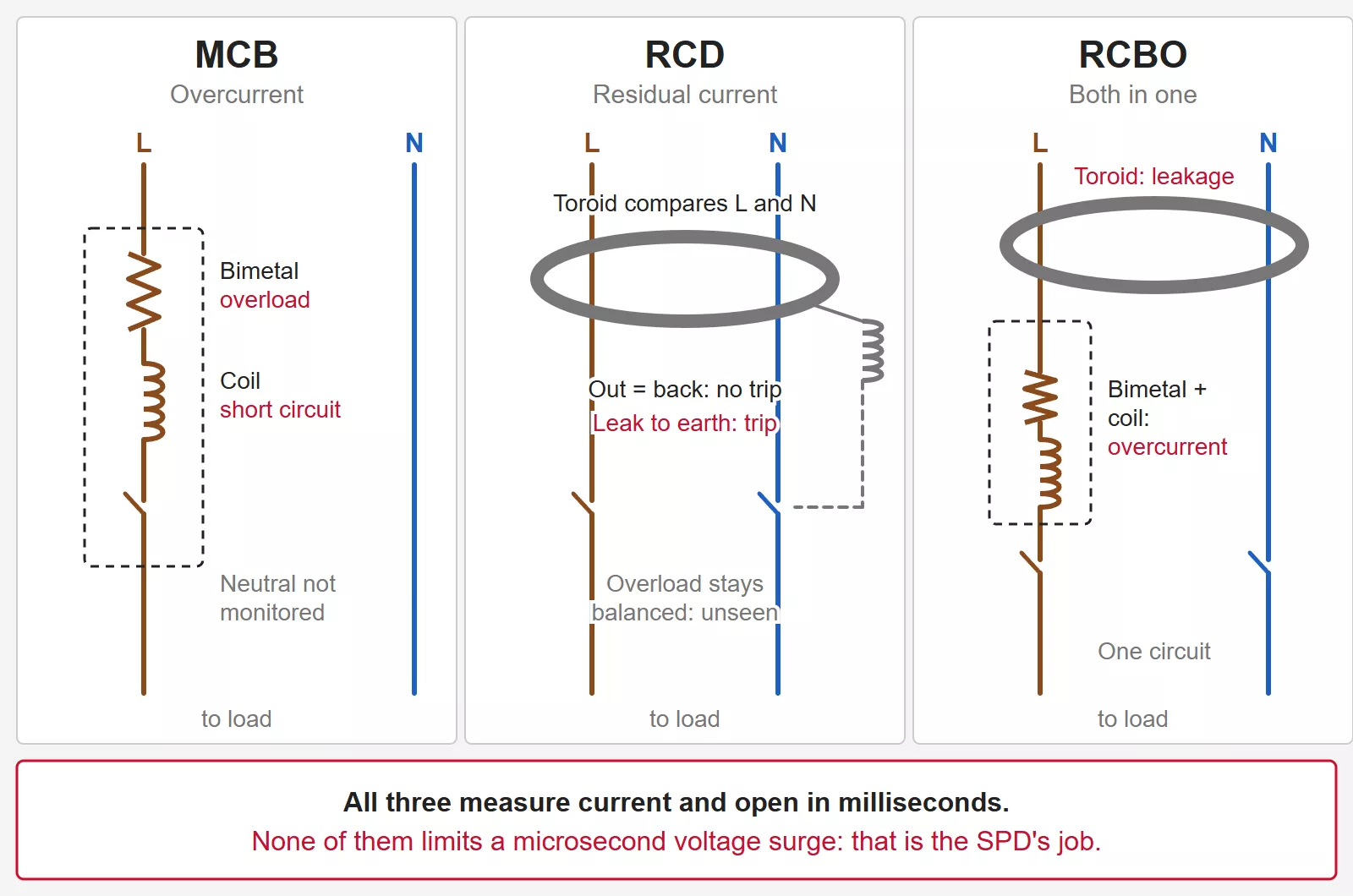
Figure 1 — What each device measures: an MCB measures current in the conductor, an RCD compares line and neutral, an RCBO does both.
Read the table by its last two rows. Each device is blind to something the other one catches, which is why an RCD on its own or an MCB on its own leaves a gap, and the bottom row is a gap all three share.
What an MCB does
An MCB has two trip mechanisms in one case. A bimetallic strip heats up as current passes through it and bends far enough to release the latch when a circuit is overloaded for long enough: 45 percent over the rating can take up to an hour, twice the rating takes seconds to a minute or two. A magnetic coil trips the breaker almost instantly when the current jumps to a short-circuit level.
The point where the magnetic trip takes over is the MCB type, also called the trip curve:
| MCB type | Instant trip at | Typical use |
| Type B | 3 to 5 × rated current | Homes, offices, resistive loads, long cable runs |
| Type C | 5 to 10 × rated current | Commercial lighting, small motors, loads with inrush current |
| Type D | 10 to 20 × rated current | Large motors, transformers, welding sets |
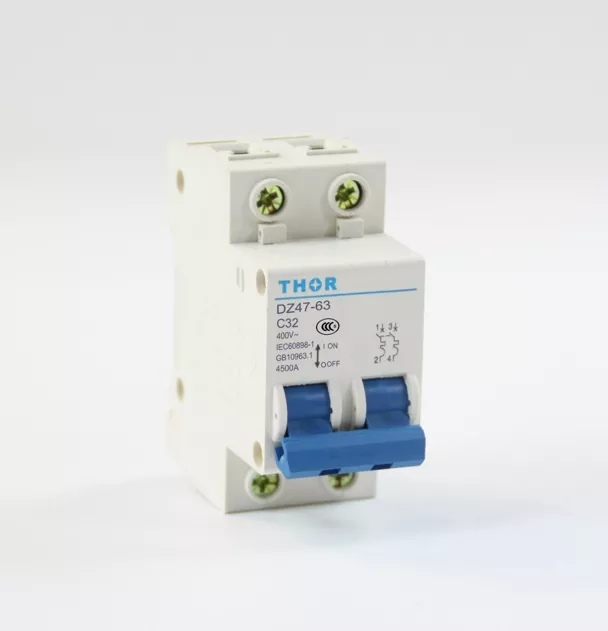
Figure 2 — Thor DZ47-63 two-pole MCB to IEC 60898-1, marked C32: the C is the trip curve and 32 is the rated current in amps.
Type B is the default for domestic circuits. A Type C or D is chosen when a load’s switch-on current would trip a Type B, and it comes with a cost explained in the next paragraph.
An MCB cannot detect a few milliamps leaking to earth, yet on many installations it is still part of the protection against electric shock. When a line conductor touches an earthed metal case in a TN system, the fault current flows back through the protective conductor and the supply’s earthed neutral, a low-impedance metal path. It is often hundreds of amps. If it reaches the MCB’s instant trip level, 160 A for a B32 (5 × 32 A), the MCB disconnects the circuit before the metal case can stay at a dangerous voltage. That is why wiring regulations publish a maximum earth fault loop impedance for every MCB type and rating, and why a C32, which needs up to 320 A to trip instantly, needs a much lower loop impedance than a B32.
In a TT earthing system, that path does not exist. The fault current returns through the installation’s own earth electrode and the soil, and electrode resistance is typically tens to hundreds of ohms. At 230 V that limits the current to a few amps. The B32 never sees 160 A, so it never trips, and the metal case can sit at a dangerous voltage indefinitely. An RCD trips on a few amps with no difficulty, which is why TT installations rely on RCDs for basic fault protection, not just as an extra layer.
What an RCD does
An RCD passes the line and neutral conductors (all phases and the neutral in a four-pole unit) through a toroidal current transformer. In a healthy circuit, the current going out on the line comes back on the neutral and the two magnetic fields cancel. When part of the current returns through earth instead, through a person or through damaged insulation, the imbalance induces a current in a sensing coil and the RCD trips.
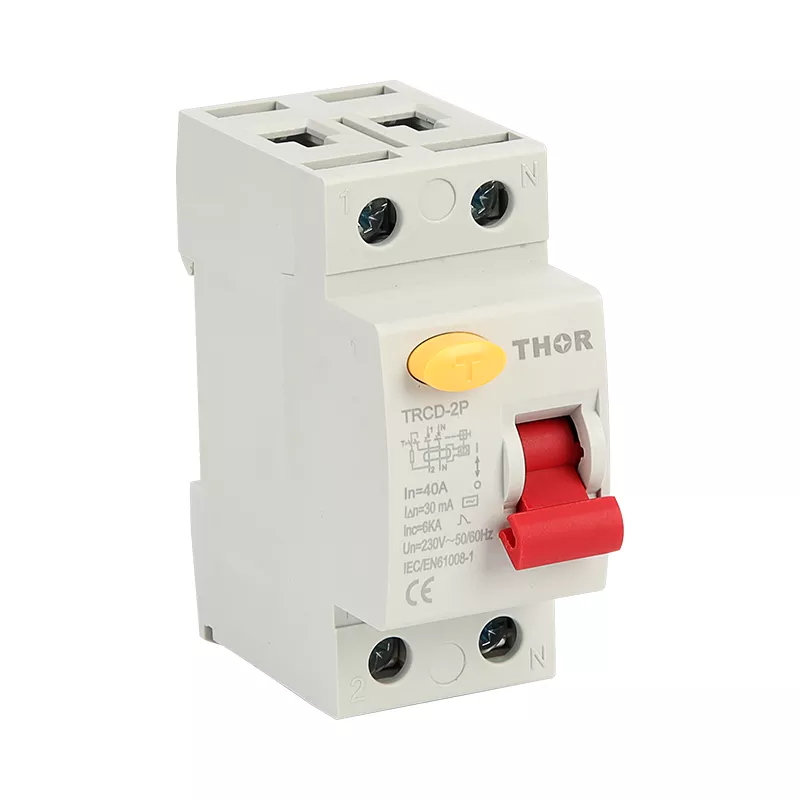
Figure 3 — Thor TRCD-2P two-pole RCD to IEC/EN 61008-1: rated current 40 A, rated residual current 30 mA, with the test button above the label.
The rating that matters is the rated residual current:
- 30 mA is the level for protecting people. In the UK, BS 7671 requires it for most socket circuits, bathrooms and cables buried in walls.
- 100 mA and 300 mA are used for fire protection and as an upstream device. A higher rating alone does not make it selective: a fault large enough to trip the 30 mA device can trip a standard 100 mA one at the same instant. For the upstream RCD to stay closed while the downstream one clears the fault, it has to be a time-delayed S-type.
An RCD is allowed to trip from about half its rating upward, so a 30 mA RCD may go at 15 to 20 mA. That matters in the tripping section below.
What an RCD cannot see is any fault where the current stays balanced. A 32 A circuit carrying 50 A, or a line touching neutral, sends the same current out and back, and the RCD stays closed while the cable overheats. An RCCB (the RCD sold as a separate device) therefore always needs an MCB or fuse with it.
RCDs also come in waveform types. Type AC detects only sinusoidal leakage; Type A also detects pulsating DC and is now the normal choice for circuits feeding electronics; Type F adds the mixed frequencies produced by variable-speed drives and heat pumps; Type B detects smooth DC and is used for some EV chargers and three-phase drives.
What an RCBO adds
An RCBO is an MCB and a 30 mA RCD in one module protecting one circuit. Electrically it does nothing the pair cannot do. What it changes is how faults are isolated.
On a split-load board, one RCD covers several MCBs. A leaking kettle trips that RCD, and every circuit behind it goes off with it, lights and freezer included. The small standing leakage of each circuit also adds up on that one RCD. With RCBOs, each circuit has its own residual-current protection: a fault takes out one circuit, and leakage from the others does not count against it.
You do not need a separate MCB on a circuit that has an RCBO, because the RCBO already contains one. The cost is a higher price per way, which is why split-load boards with two RCDs are still common, but new boards are moving toward all-RCBO.
Why an RCD trips but the MCB does not
When the RCD drops and the MCBs stay on, the circuit has not drawn too much current. Something is sending current to earth, or into the neutral-earth path. The usual causes, roughly in order of how often they turn out to be the answer:
- A faulty appliance: moisture in a kettle or immersion heater element, a washing machine heater, an outdoor socket. Unplug everything on the affected circuits, reset, and plug items back one at a time.
- Accumulated leakage: computers, LED drivers and other electronics leak a little current to earth through their filter capacitors. Ten or fifteen of them on one 30 mA RCD, which may trip at 15 to 20 mA, can be enough to trip it when they switch on together. The fix is to spread the load over more RCDs or move to RCBOs.
- A neutral-to-earth fault: a neutral touching earth downstream of the RCD splits the return current between the two, and the RCD trips whenever that circuit, or sometimes an unrelated one, is loaded. An insulation resistance test finds it.
- Damaged cable: a nail or screw through a cable, or water in an outdoor junction box.
- A surge: a nearby lightning strike or a large load switching on the same supply puts a fast transient on the line. Filter capacitors and any SPD connected after the RCD send part of that transient to earth, the current is unbalanced for a few microseconds, and a standard RCD may trip. If trips line up with thunderstorms, or with a big compressor or motor starting, this is the likely cause. A reset that holds does not prove the surge left the equipment undamaged, so check anything electronic on the circuit.
The last cause is the one installers fix by moving or adding a device, which is where the SPD comes in.
What none of them stop: surges
MCBs, RCDs and RCBOs all act on current, and all take milliseconds to open. A surge is a voltage transient of several kilovolts lasting tens of microseconds. It passes through a closed breaker before the contacts start to move, and most surge damage involves no overload and no leakage at all: the overvoltage punctures insulation inside a power supply, a drive or a control board, and the breaker never sees a fault.
The device that deals with this is an SPD. It sits between the live conductors and earth, does nothing at normal voltage, and conducts for the duration of a surge to hold the voltage at a level the equipment can withstand. The detailed comparison is in our article on SPD vs circuit breaker. The short version: the breakers protect cables and people from the power system’s own current, and the SPD protects equipment from voltage arriving from outside.
Where the SPD goes relative to the RCD
An SPD sends surge current to earth, and an RCD trips on current going to earth. Put them in the wrong order and one fights the other.
The preferred position is on the supply side of the RCD. Surge current then flows to earth without ever passing through the RCD, so there are no nuisance trips and the RCD is not stressed by the surge. IEC 60364-5-534, and BS 7671 in the UK, place SPDs at the origin of the installation for this reason.
On a TT supply, that position has a catch. Upstream of the RCD, the only protection against an SPD failing short to earth is the overcurrent device, and as the MCB section showed, a TT earth fault draws only a few amps, far too little to trip it. So a supply-side SPD on a TT system must use the arrangement with a spark gap between neutral and earth: 1+1 on a single-phase supply, 3+1 on a three-phase one. The varistors sit between each line and the neutral. If a varistor fails short, it shorts line to neutral, the fault current is high, and the backup breaker clears it. The neutral-to-earth gap conducts only during a surge. Our article on 4+0 and 3+1 SPD configurations covers the three-phase wiring; the single-phase 1+1 follows the same logic with one line.
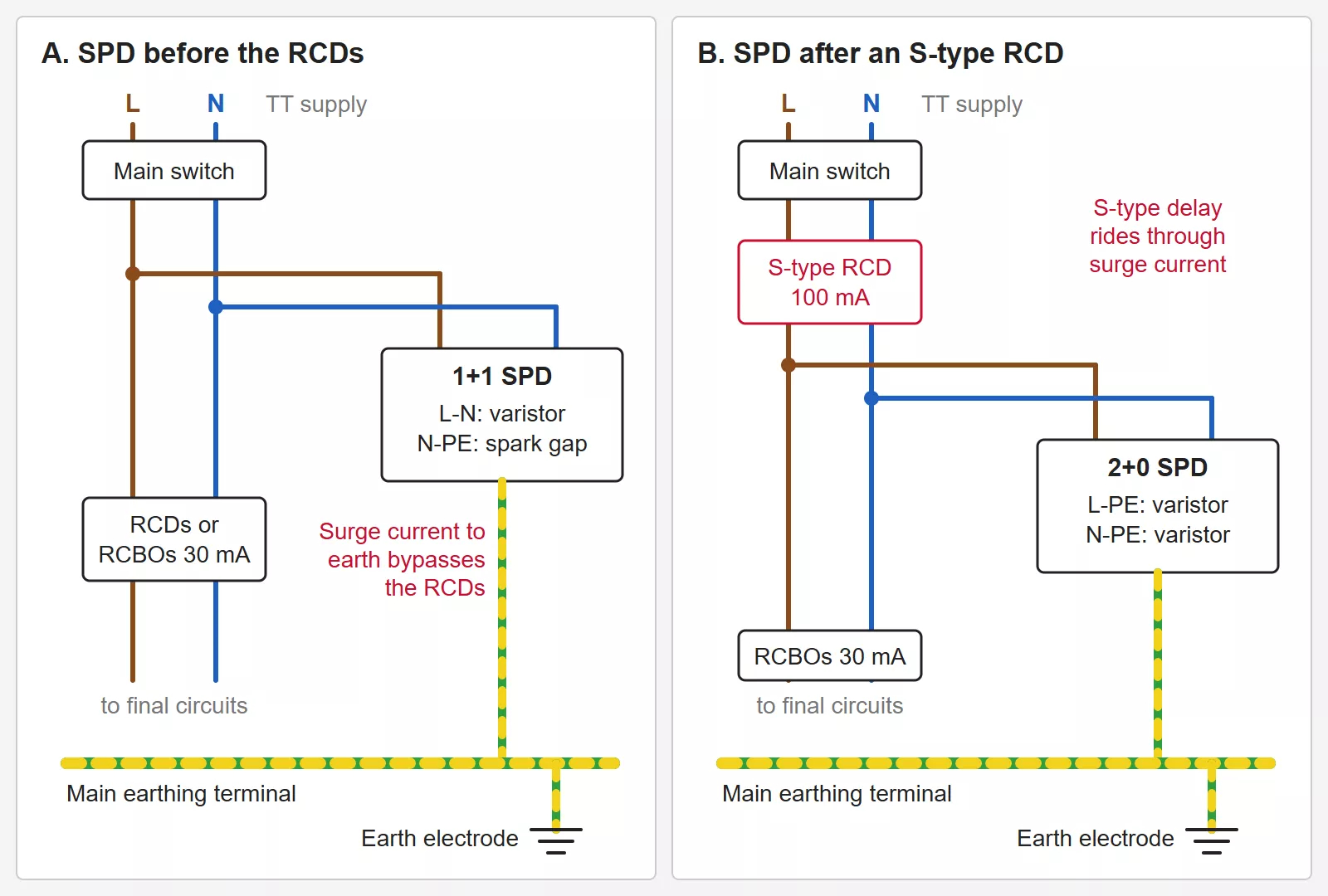
Figure 4 — SPD positions on a single-phase TT board: a 1+1 SPD on the supply side of the RCDs, or an SPD after a time-delayed S-type RCD.
When the SPD has to go after an RCD, for example on a sub-board or in a retrofit with no room at the incomer, put a time-delayed S-type RCD (usually 100 mA) upstream of it. S-type RCDs are built to ride through surge currents, and the 30 mA RCDs or RCBOs on the final circuits then sit downstream of the SPD, where the surge has already been diverted. This is the common layout for single-phase TT installations in the UK: S-type main RCD, SPD, then 30 mA RCBOs. Behind an RCD, an SPD with varistors from each conductor to earth (2+0 single-phase, 4+0 three-phase) is acceptable, because the RCD clears an SPD failure to earth.
Wherever the SPD goes, it needs overcurrent protection in front of it in case it fails. That can be the upstream device already in the circuit, if its rating is no higher than the maximum backup rating in the SPD maker’s datasheet; only when the upstream device is larger does the SPD need its own MCB or fuse. The breaker cannot see a surge, and the SPD relies on a breaker if it ever fails, so the two cover each other’s weak points. When a separate breaker is needed, how to size it, including why a small Type B MCB can trip on a large surge current, is covered in what size MCB for SPD.
FAQ
Can I use an RCD instead of an MCB?
No. An RCD has no overcurrent protection, so a circuit protected only by an RCD would let an overloaded or short-circuited cable overheat. If you want a single device per circuit, use an RCBO, which contains both.
Do I need an MCB if I have an RCBO?
Not on the same circuit. An RCBO already includes the overload and short-circuit protection of an MCB. Adding an MCB in series only adds a second point that has to be coordinated.
Does an MCB protect against electric shock?
Partly. On a TN supply with a low enough earth fault loop impedance, an MCB disconnects a line-to-earth fault on metalwork fast enough to protect against shock from that metalwork. It does nothing for a person touching a live conductor directly: 30 mA through a body is invisible to a 32 A breaker. That is the job of a 30 mA RCD.