
IEC 61643 is a family of international standards for low-voltage surge protective devices, not a single document. Different parts cover AC power systems, DC power systems, photovoltaic arrays, and telecom and signalling lines. Within each of those applications, the series splits again: one document sets what the product must survive, another sets how to select and install it.
That structure changes how you read a quotation. A supplier line saying “complies with IEC 61643” carries very little information on its own, because it does not tell you which part, which edition, or whether the document being cited is one a product can be certified against at all.
What is IEC 61643?
IEC 61643 is the international standard family for low-voltage surge protective devices (SPDs), developed under IEC technical committee 37. It covers SPDs on circuits rated up to 1 000 V AC or 1 500 V DC, and splits along two axes: the application the SPD is wired into, and whether a document sets product requirements or selection guidance.
The application axis is the one most people already know. An SPD on a three-phase distribution board and an SPD on a PV string face different voltages, different fault behaviour and different test regimes, so they answer to different documents.
The second axis gets missed far more often, and it is the one that decides what a certificate can legitimately say. For each application, IEC publishes a requirements and test methods document and, usually, a separate selection and application principles document alongside it. The first of those is a product standard: a manufacturer builds to it, a laboratory tests samples against it, and a certificate can name it. The second is design guidance written for the engineer specifying and installing the system, and no product is ever tested against it.
Two subcommittees divide the work. SC 37A writes the standards for finished SPDs, while SC 37B writes the standards for the components inside them, such as varistors and gas discharge tubes.
The IEC 61643 family at a glance
The table below lists the current SPD parts, with the edition each one is at.
| Standard | Edition | Covers |
| IEC 61643-01:2024 | 1.0 | General requirements and test methods, common to all SPDs |
| IEC TR 61643-03:2024 | 1.0 | SPD testing guide (Technical Report) |
| IEC 61643-11:2025 | 2.0 | AC low-voltage power systems, requirements and test methods |
| IEC 61643-12:2020 | 3.0 | Low-voltage power systems, selection and application principles |
| IEC 61643-21:2025 | 2.0 | Telecom and signalling networks, requirements and test methods |
| IEC 61643-22:2015 | 2.0 | Telecom and signalling networks, selection and application principles |
| IEC 61643-31:2018 | 1.0 | PV installations, requirements and test methods |
| IEC 61643-32:2017 | 1.0 | PV DC side, selection and application principles |
| IEC 61643-41:2025 | 1.0 | DC low-voltage power systems, requirements and test methods |
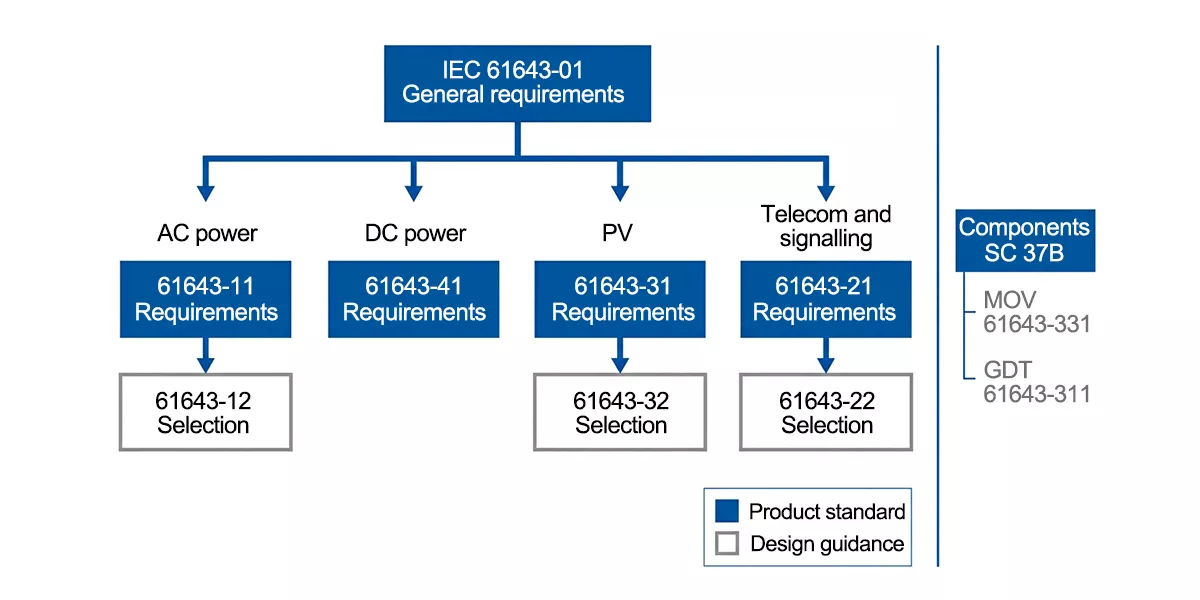
Figure 1 — Structure of the IEC 61643 series: a common general standard, four application branches, and the component standards published under a separate subcommittee.
Two things are worth pulling out of that table. Part 41 is new, and it covers DC low-voltage power systems as a category of its own rather than folding them into the PV parts. Battery storage, telecom power and the DC side of EV charging equipment now have a product standard written for them instead of borrowing one. The telecom side moved in 2025 as well, with Part 21 now at edition 2.0.
A note on how these are numbered, because the two numbers in a reference do different jobs. The year after the colon is the year that version published. The edition number counts how many times the document has been rewritten from scratch. Part 12 is at edition 3.0 from 2020, so it has been through two full revisions since it first appeared. Part 31 is still at edition 1.0 from 2018, meaning the 2018 text is the original. Both numbers matter when you compare two certificates: a document naming an older year is not automatically out of date if that part has not been revised since.
Requirements standards and selection guides are not the same thing
Read the part numbers as a pattern. Where the series publishes a pair, the part ending in 1 sets requirements and test methods, and the part ending in 2 sets selection and application principles.
| Application | Product standard | Design guidance |
| AC low-voltage power | Part 11 | Part 12 |
| Telecom and signalling | Part 21 | Part 22 |
| Photovoltaic | Part 31 | Part 32 |
| Gas discharge tubes | Part 311 | Part 312 |
| Metal oxide varistors | Part 331 | Part 332 |
The practical consequence: a surge protective device cannot be certified to Part 12. That document tells a designer where to put SPDs and how to coordinate them. It contains nothing a laboratory can subject a sample to. A datasheet or quotation claiming certification against a selection-and-application part has confused a design guide with a product standard, and it is a quick thing to check before you go any further into a supplier’s document package.
The pattern holds for the pairs, not for every part in the series. Part 41 currently has no selection counterpart. Several component standards exist only on the requirements side. The two Technical Reports, Part 03 and Part 333, sit outside the pairing altogether as guidance documents.
For the wider question of what a genuine document package looks like and how to check one, see our guide to verifying a surge protection device certificate before buying.
What changed in IEC 61643-11:2025
IEC 61643-11:2025 is edition 2.0, published in June 2025. It cancels and replaces the first edition from 2011 and is a technical revision.
The largest change is structural. Requirements common to every SPD moved out into IEC 61643-01:2024, a new general standard. Part 11 now holds only what is specific to AC applications, and it has to be read together with the current edition of Part 01. Its clause numbering follows Part 01 rather than running in its own sequence, and clauses of Part 01 that Part 11 does not call up simply do not apply to AC SPDs.
Alongside that reorganisation, the foreword lists the technical changes against the 2011 edition:
- Clarification of whether a given test applies to a complete SPD, to a single mode of protection, or to a complete SPD assembly
- Measurement of the voltage protection level on combined modes of protection between live conductors and PE
- A duty test for Type 1 and Type 2 SPDs with follow current, checking how the follow current value varies at lower impulse currents
- Revised short-circuit current test requirements, to cover current internal SPD disconnector technologies
- Stronger dielectric test requirements for the SPD main circuits, plus new dielectric and clearance requirements for electrically separated circuits
One point of realism about what this means commercially. Edition 2.0 is barely a year old, and certification against a new edition takes time to work through laboratories and product ranges. A large share of the SPD certificates in circulation today, Thor’s included, still name IEC 61643-11:2011. A 2011-based certificate is not a red flag by itself. What is worth asking a supplier is which edition their evidence covers, so that you are comparing like with like across quotations.
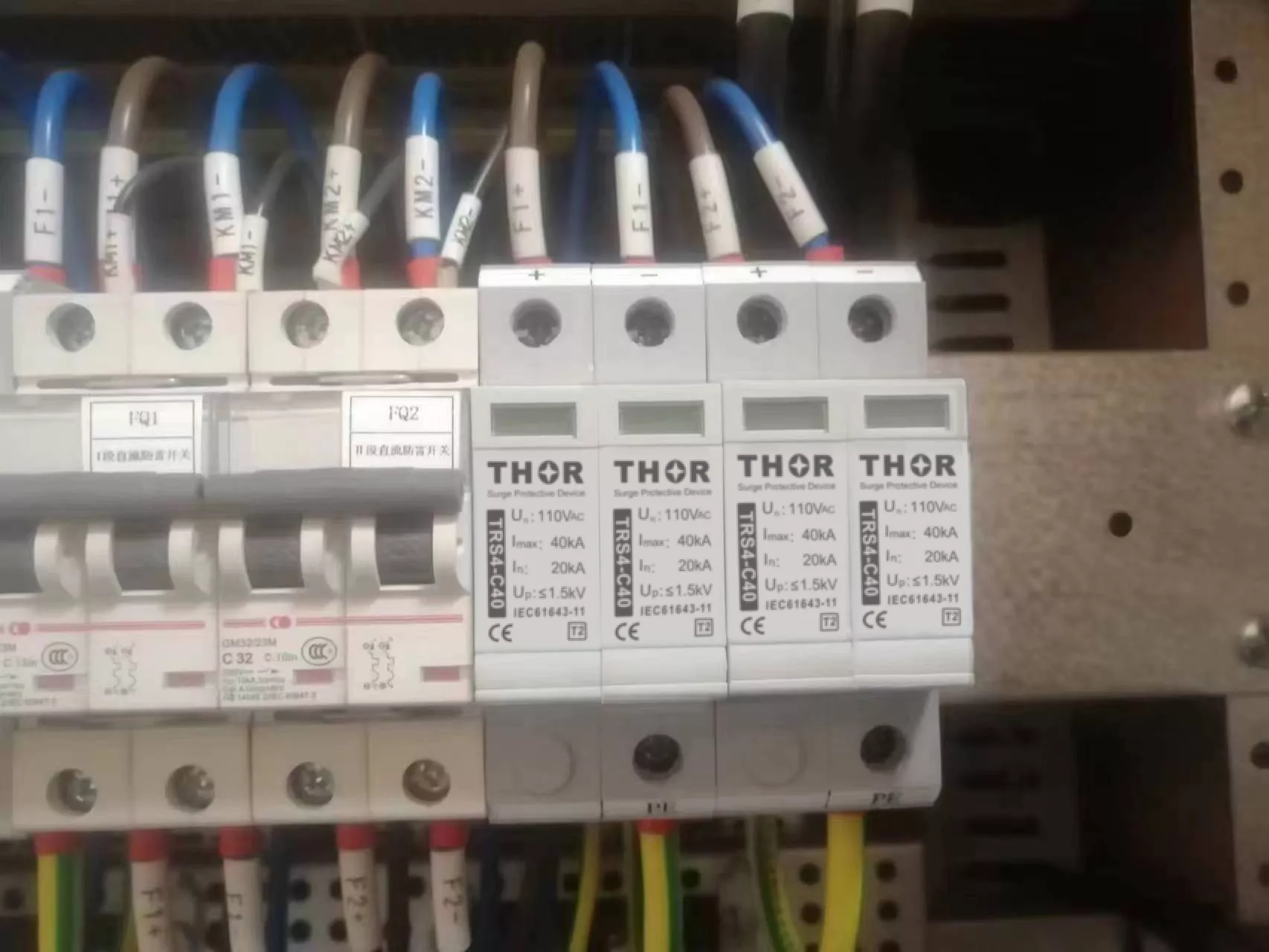
Figure 2 — Thor Type 2 SPD modules on a DIN rail with their backup circuit breakers. The product labels cite IEC 61643-11, the part that governs devices in this position.
Which part applies to your system
Match the part to the circuit the SPD is wired into, not to the building or the project type.
| Your system | Product standard | Design guidance |
| AC mains distribution, single or three phase | Part 11 | Part 12 |
| PV array DC side, up to 1 500 V DC | Part 31 | Part 32 |
| DC power circuits that are not PV, such as battery, telecom or EV charger DC | Part 41 | none published |
| Ethernet, RS485, coaxial and other signal lines | Part 21 | Part 22 |
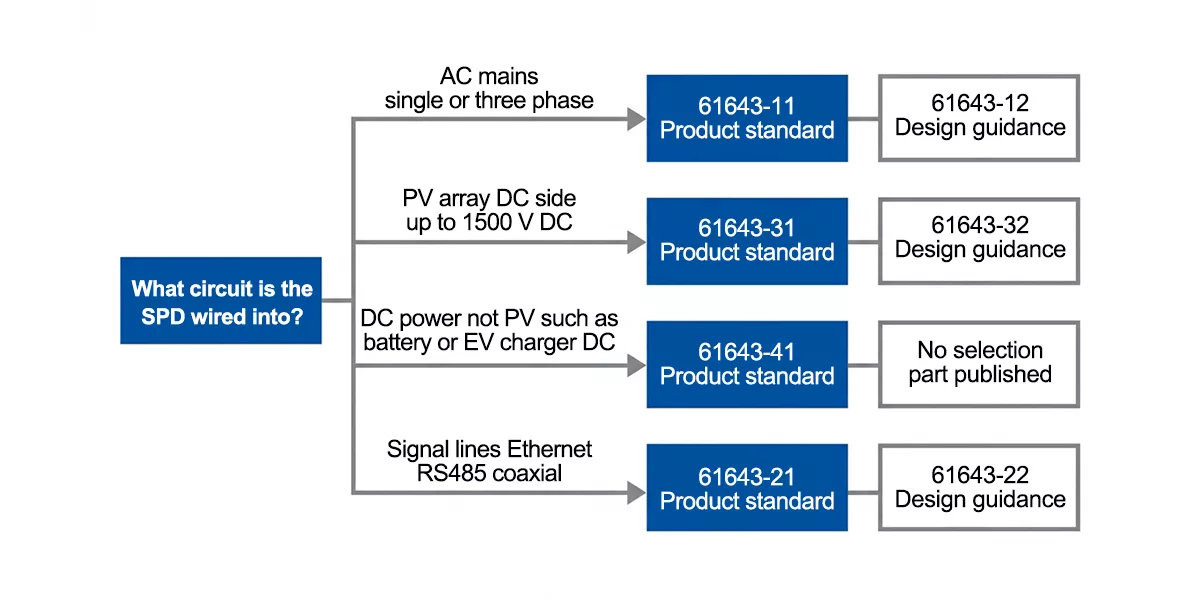
Figure 3 — Selection path from the circuit an SPD is wired into to the part of the series that governs it.
A mixed site usually needs more than one. A rooftop PV installation with a grid-tied inverter has a DC side under Part 31 and an AC side under Part 11, and if the site also runs monitoring over Ethernet, the data line falls under Part 21.
Three parts, one building.
Thor’s AC surge protection device range is built and certified on the Part 11 path. The TRS4-C40 is a Type 2 module rated Uc 275 V AC, In 20 kA and Imax 40 kA at 8/20 µs, tested to IEC 61643-11:2011/T2. On the PV side, the TRS3-C40 follows IEC 61643-31:2012 instead, with In 20 kA, Imax 40 kA and Iscpv 10 kA. Same manufacturer, same factory, different product standard, because the circuits behave differently.
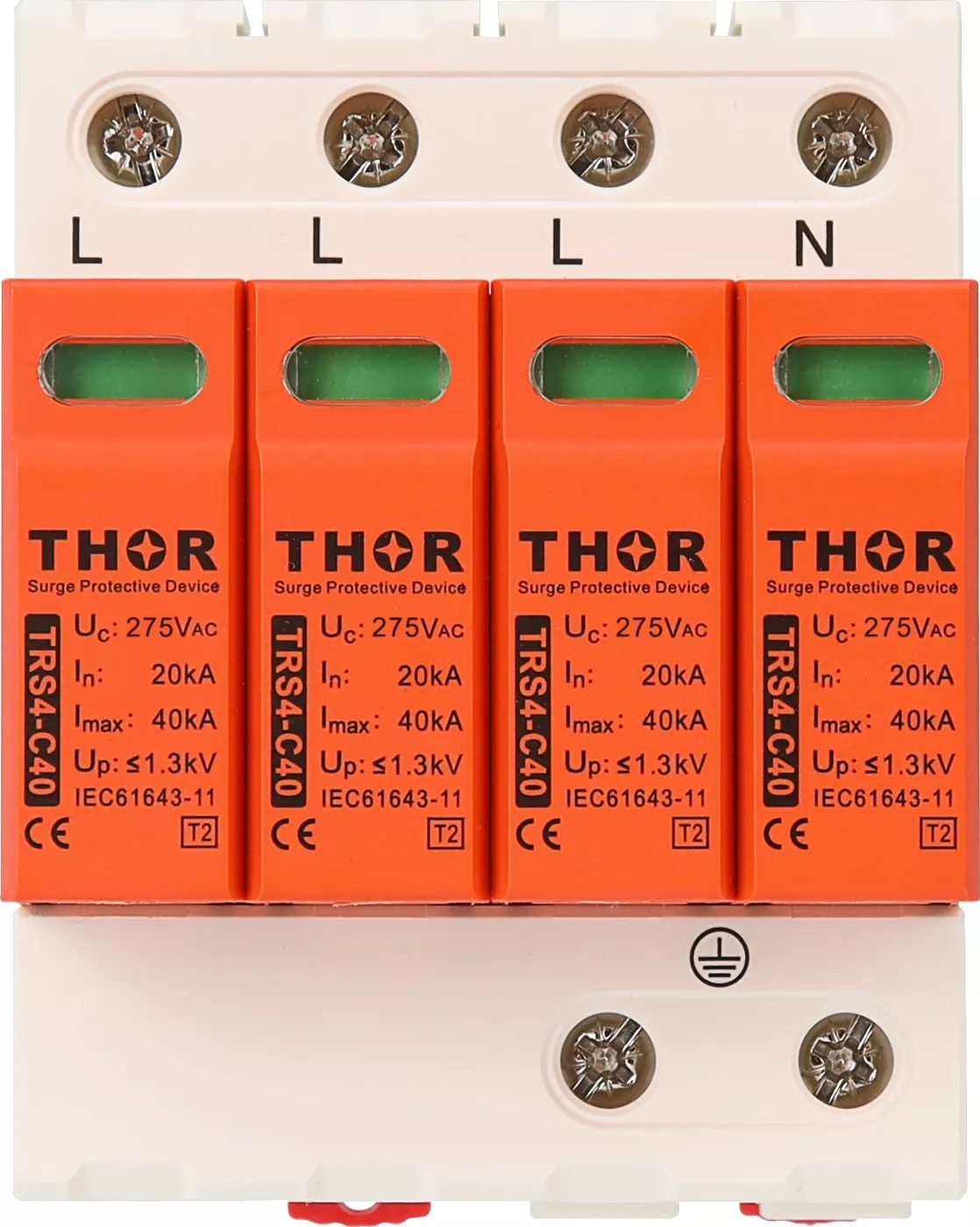
Figure 4 — Thor TRS4-C40 in a 4-pole 3L+N arrangement: *Uc* 275 V AC, *In* 20 kA, *Imax* 40 kA at 8/20 µs, pluggable modules with green status windows.
Type selection within Part 11 is a separate question from which part applies. For where Type 1, Type 2 and Type 3 devices belong, see our Type 1 vs Type 2 vs Type 3 SPD comparison, and for how cascaded devices share energy, our guide to SPD coordination, which follows Part 12.
The component standards behind MOV and GDT
Occasionally a datasheet cites a part number in the 300s. Those belong to the component standards, published under SC 37B, and they describe the parts inside an SPD rather than the finished device.
| Component | Requirements | Selection |
| Metal oxide varistor (MOV) | Part 331:2020 | Part 332:2024 |
| Gas discharge tube (GDT) | Part 311:2013 | Part 312:2013 |
| Avalanche breakdown diode (ABD) | Part 321:2001 | none published |
| Thyristor surge suppressor (TSS) | Part 341:2020 | none published |
A varistor tested to Part 331 is a qualified component, which is not the same statement as a finished SPD tested to Part 11. If a certificate names a 300-series part alone, it covers what went into the device, not the device. Background on the components themselves is in our articles on the metal oxide varistor (MOV) and the gas discharge tube (GDT).
FAQ
What is the difference between Part 11 and Part 12?
Part 11 is a product standard. It sets the requirements and test methods for SPDs connected to AC low-voltage power systems, and a laboratory can test a sample against it. Part 12 is design guidance covering where SPDs go in an installation and how cascaded devices are coordinated. A device is certified to Part 11, never to Part 12.
Which part applies to DC and solar SPDs?
They are two different parts. SPDs on the DC side of a photovoltaic installation, up to 1 500 V DC, fall under Part 31, with Part 32 giving the selection and coordination principles. DC power circuits that are not photovoltaic, such as battery systems, telecom power or the DC side of EV charging equipment, fall under Part 41.
Is IEC 61643-11:2011 still valid?
The 2011 first edition has been cancelled and replaced by edition 2.0, published in June 2025. Certificates issued against the 2011 edition remain widely in circulation, because recertification against a new edition takes time to move through test laboratories and product ranges. Ask a supplier which edition their test evidence names so that quotations can be compared on the same basis.
Can a surge protective device be certified to IEC 61643?
Not to the family as a whole. Certification is always against a specific part, such as Part 11 for AC power SPDs or Part 31 for PV SPDs, and since 2024 the AC path also draws on the general requirements in Part 01. A claim of conformity to the series with no part number is incomplete.
Where can I get the IEC 61643 standard?
The standards are sold by IEC through its webstore, and national standards bodies publish their own adopted versions, such as the EN equivalents in Europe. They are copyrighted documents, so manufacturers cannot distribute copies. What a supplier can give you is the test report and certificate that name the relevant part and edition.
Thor Electric SPD ranges and standards
Thor Electric manufactures AC, PV, DC and signal-line surge protective devices, each built to the part of the series that governs its circuit, with IEC, TUV, CE, CB, RoHS and ISO certification across the ranges. Samples, full test documentation and OEM or ODM production are available. Tell us the system voltage, earthing arrangement and circuit type, and we will point you to the right range and the matching documents. Contact our engineering team with your specification.